The most dangerous sentence in ecommerce is “the new site launches Tuesday”. Full redesigns shipped on faith lose revenue more often than they gain it, and we know because brands come to us afterwards, asking what happened. Usually nothing went wrong on launch night; the gamble was taken months earlier, when the project was scoped as a single cutover. Here is the version where you keep the upside and skip the bet.
An ecommerce redesign does not have to be a leap of faith. The staged approach audits what already works before touching it, ships the new design template by template, runs the biggest changes as experiments at 50% of traffic before 100%, watches guardrail metrics at every step, and protects search rankings with a redirect checklist. It takes longer to finish, and it is dramatically less likely to cost you a quarter’s revenue.
Why redesigns fail
Start with the uncomfortable base rate: new is not the same as better. A redesign bundles dozens of design decisions into one release; some help, some hurt, and the losers ship inside the same parcel as the winners. Across our archive of 1640+ ecommerce experiments, design changes lose or go flat more often than they win when tested individually, and there is no reason forty of them shipped simultaneously should net out positive. A faith launch does not remove that risk, it just stops measuring it.
Two forces make it worse. Returning customers, your most profitable segment, carry muscle memory for the old site, and a redesign resets it: for weeks they hunt for a menu that moved, which shows up in analytics as a conversion dip that punishes your best traffic hardest. And search engines re-evaluate a rebuilt site the same way: changed URLs, restructured headings and dropped internal links can knock organic traffic down just as conversion wobbles, which is how a redesign ends up losing on both terms of the revenue equation at once.
The faith-launch autopsy
The post-launch pattern we get asked to diagnose is depressingly consistent. One store came to us after conversion fell from 2.4% to 2.0% in the six weeks after a full relaunch, a 17% relative drop the launch deck had promised would be a lift. The painful part is not the dip; it is that with forty changes shipped at once, nobody can say which of them did the damage. The old theme is gone, the diff is unreadable, and “roll it back” now means a second redesign. Recovery from that position is guesswork, performed under pressure, on a site the team has just spent six months learning to distrust.
Audit what works before you touch it
The staged alternative starts with an audit, because the most expensive redesign mistake is redesigning your winners. Funnel data, heatmaps and past test results will tell you which templates already convert well and which leak; the elements that are working, a product page layout shoppers clearly navigate, a checkout that completes at a healthy rate, get carried into the new design deliberately rather than redrawn for variety. Design effort then concentrates where the evidence says the current site loses money, which is usually a much shorter list than the creative brief assumed.
Ship it template by template
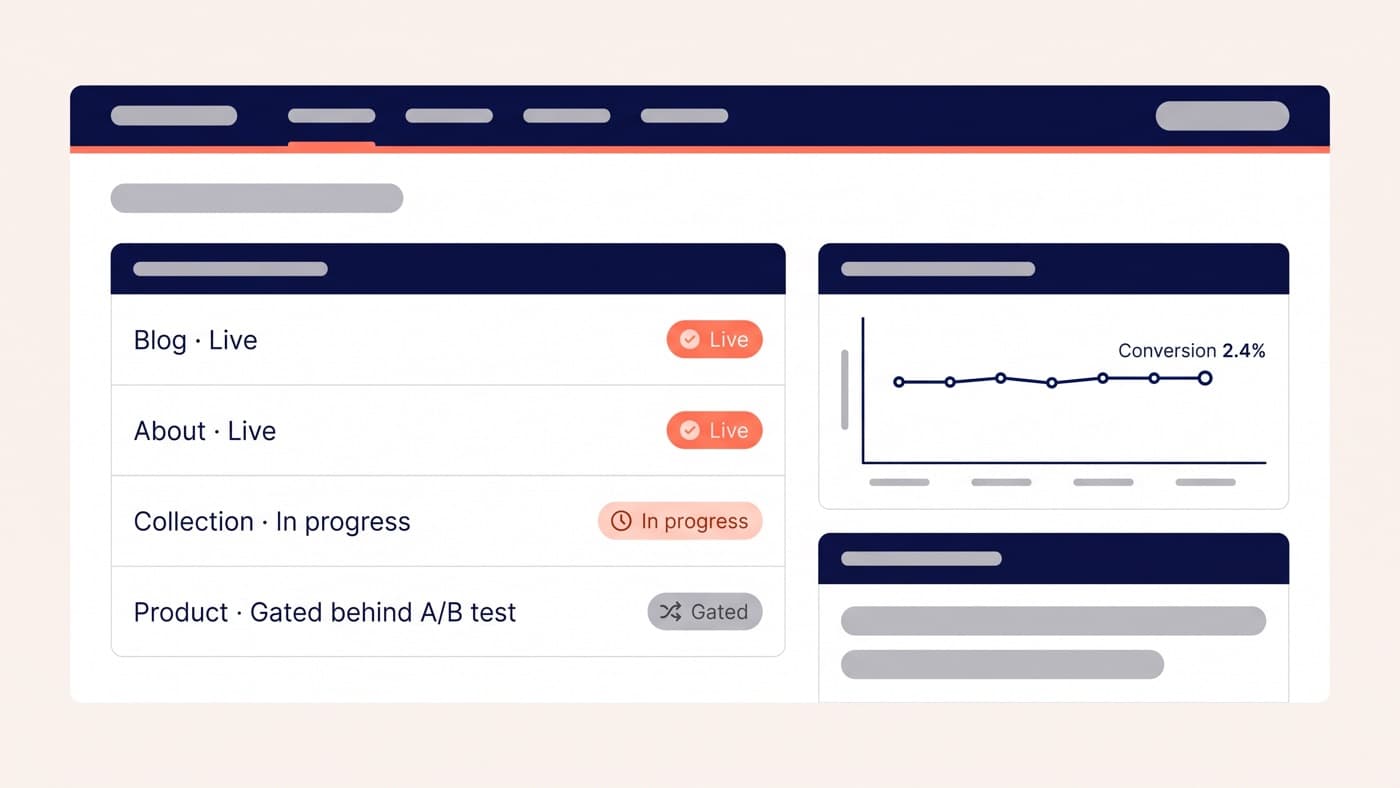
With the audit done, the rollout goes template by template, lowest stakes first. Content pages and the about page ship early, because a misstep there costs little and teaches the team the deployment rhythm. Collection templates follow, then the product template, then anything touching cart and checkout, with each step held for a week or two of clean data before the next begins. The store never has more than one meaningful change in flight, so when a metric moves, you know why. That is the entire trick, and it is the discipline faith launches pay for skipping.
Test the biggest changes as experiments
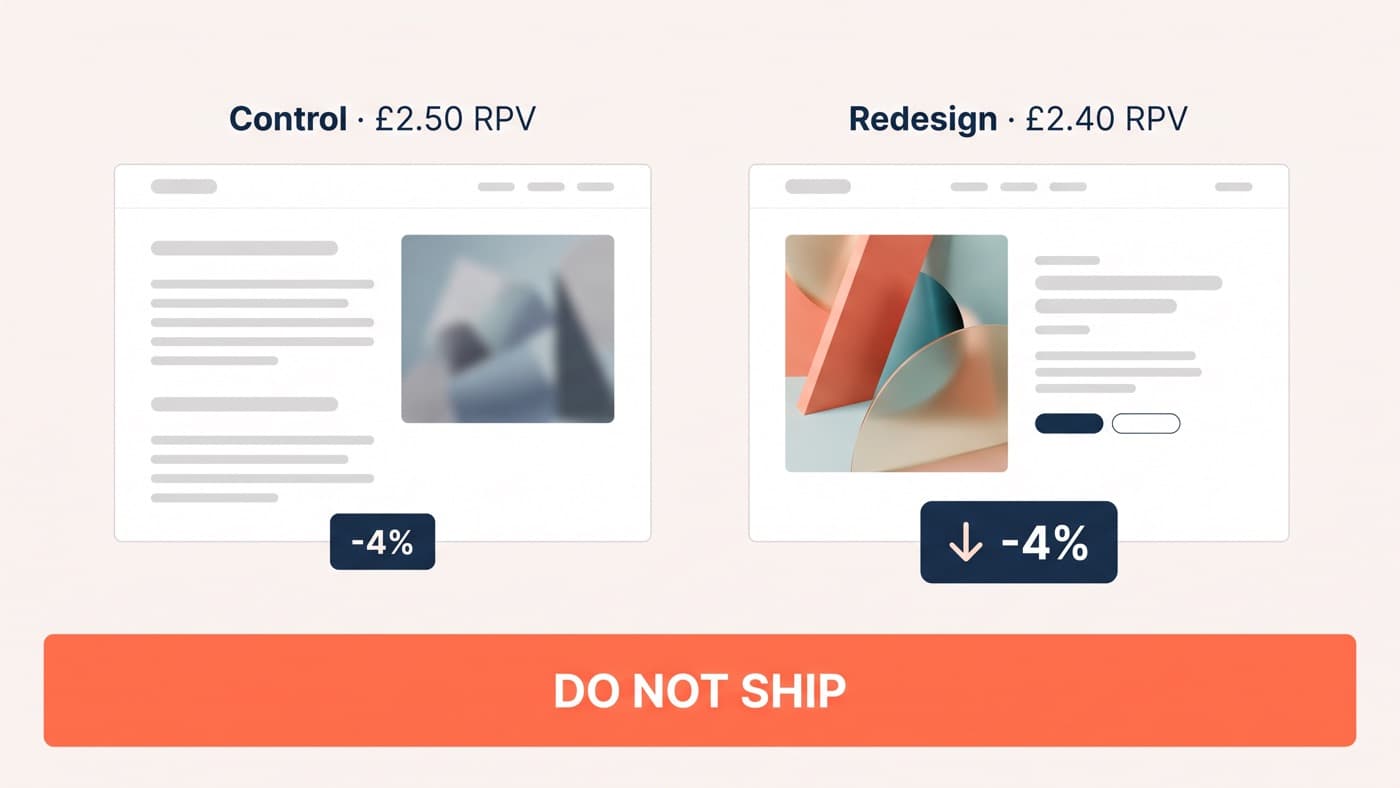
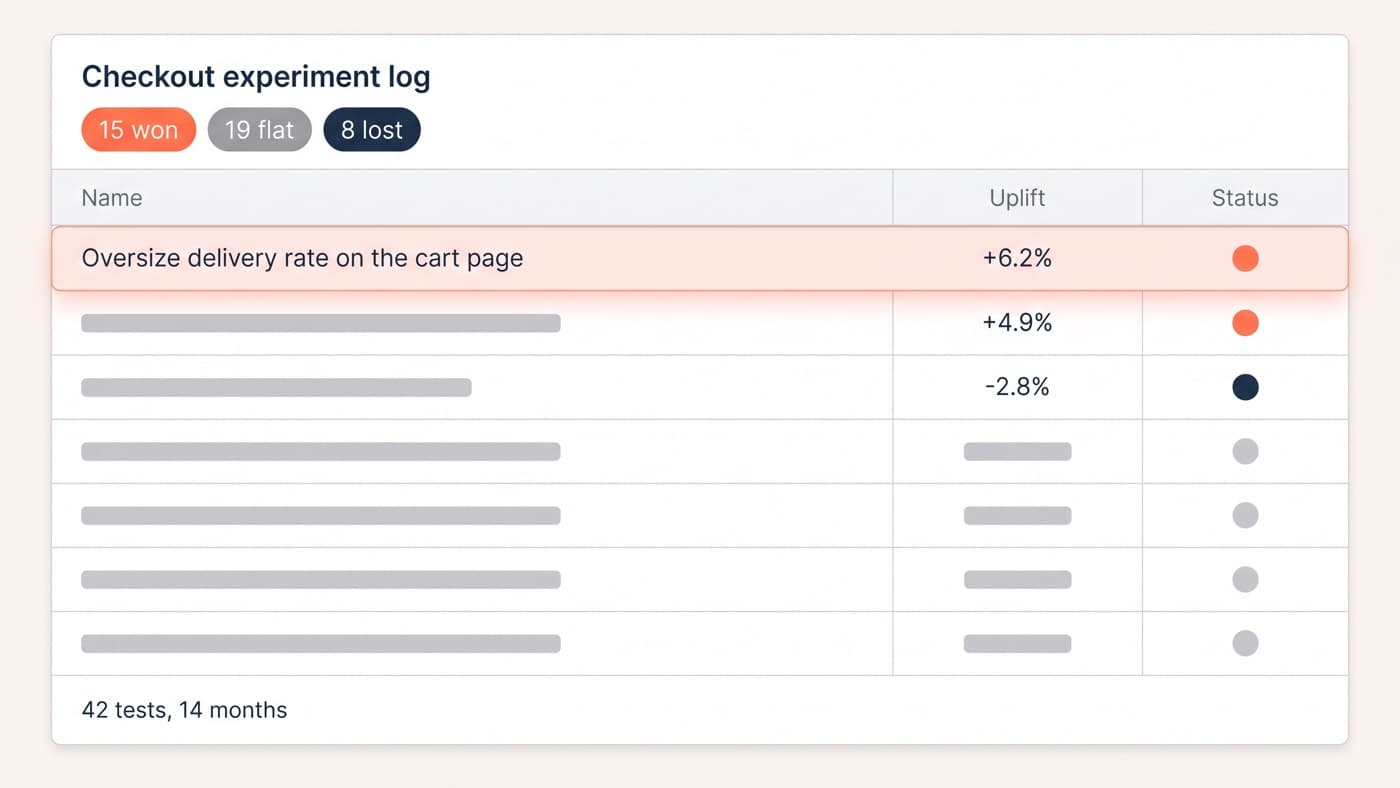
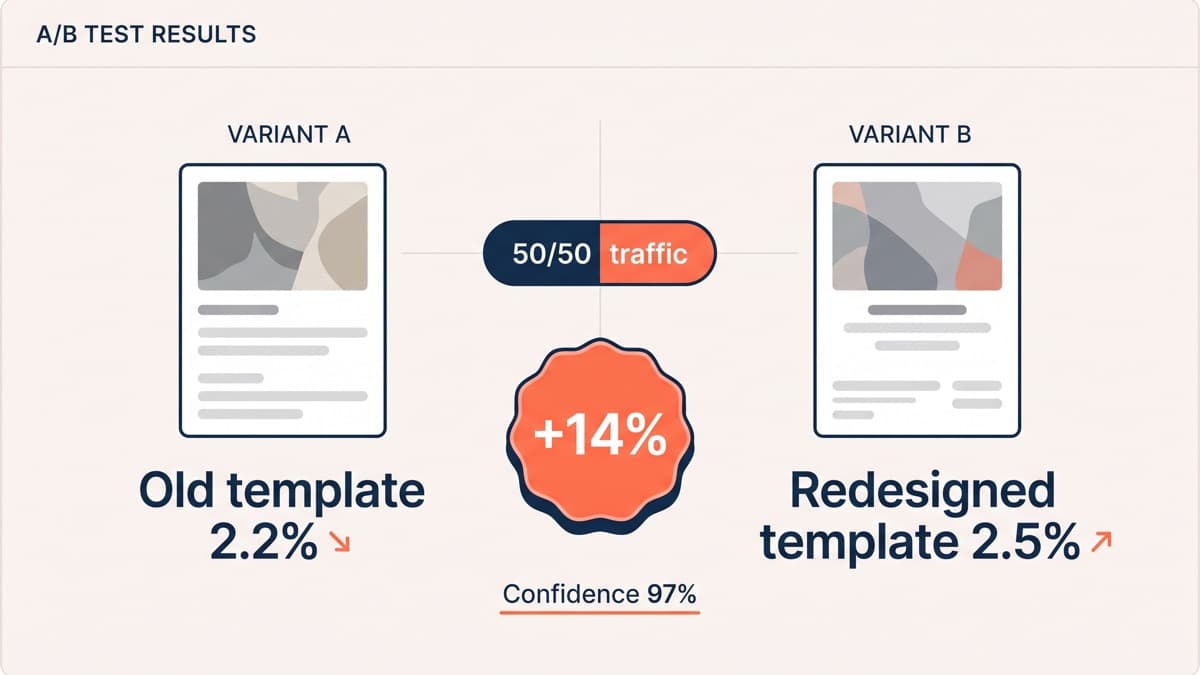
The templates that carry your revenue deserve more than careful sequencing; they deserve a controlled experiment, new template against old at a 50/50 split. One redesigned product template we tested this way lifted conversion from 2.2% to 2.5%, a 14% relative gain at 97% confidence, and shipped with the launch risk already spent. Another looked at least as good in the design file and lost by 9%; it never met full traffic. That second result is the point: the test did not slow the redesign down, it stopped a faith launch from shipping the loss. We hold our own work to the same rule, and the discipline scales: our 42-test checkout case study is what it looks like applied to the scariest template of all.
Guardrails during the rollout
Every stage of the rollout runs against a small set of guardrail metrics, agreed before anything ships, with rollback thresholds written down in advance so the decision is mechanical rather than political:
- Conversion rate on the template just released, against its pre-release baseline over comparable weeks.
- Revenue per visitor and average order value, so a lift bought by the wrong orders gets caught.
- Checkout completion, which catches upstream damage that blended conversion hides.
- Organic sessions and rankings for the pages whose URLs or structure changed.
- Page speed on the new templates, because redesigns habitually ship heavier.
- Support tickets and chat volume, the fastest signal that returning customers are lost.
The picture you want from that dashboard is boring: conversion holding at 2.4% while template after template ships underneath it. A staged redesign succeeds quietly, which is one honest reason agencies prefer selling the dramatic version.
Protect your search rankings
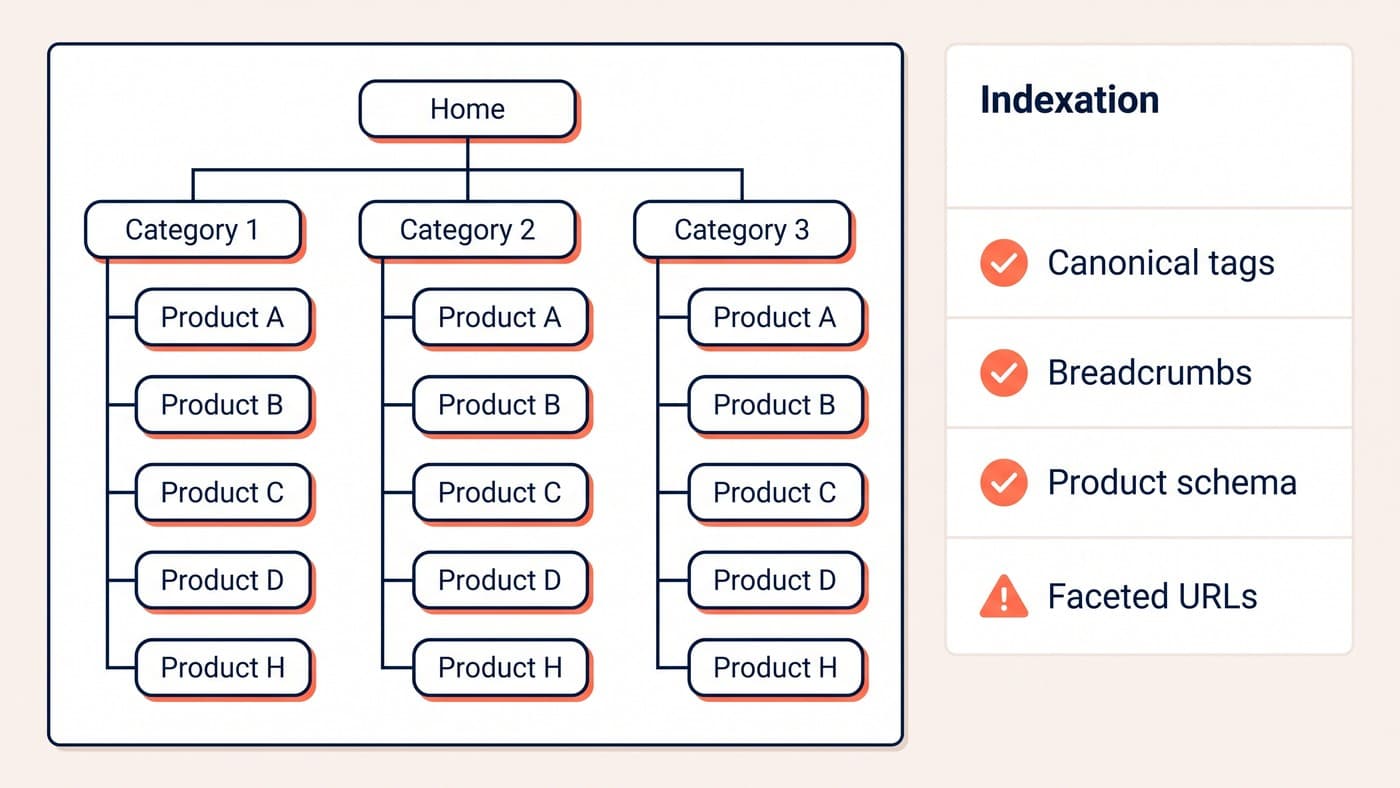
The SEO checklist is unglamorous, and skipping it is how redesigns lose traffic they never even measure. Map every old URL to its new home with a 301 redirect before launch, and keep URLs unchanged wherever there is no strong reason to move them. Preserve the heading structure and body copy of pages that rank; a redesign is a visual project, not a licence to rewrite title tags. Re-point internal links directly rather than letting them bounce through redirect chains, keep the XML sitemap current, and crawl the staging site with the same tools you would point at a competitor. The structural half of this overlaps heavily with our WordPress ecommerce SEO guide, and the principles are identical on any platform.
When a full cutover is unavoidable
Sometimes the staged path is closed, usually because the redesign is really a replatform and the old and new stores cannot share traffic template by template. The de-risking then changes shape: replicate before you improve, launching a like-for-like build first so the only variable is the platform itself; schedule the cutover for your quietest season; freeze every other change around it; and hold the redesign ideas for the experiment backlog once the new store has a stable baseline. It is slower than launching everything at once, which is another way of saying it is the version where you find out what each change actually did. If the move involves Shopify, that like-for-like discipline is core Shopify development work, and it is worth insisting that any partner you brief can describe it unprompted.