You are paying Meta and Google for every click, and then sending that traffic to a product page built for everyone: organic browsers, returning customers and your paid visitors alike. Message match, making the page continue the conversation the ad started, is the cheapest conversion lever in paid acquisition, and most stores ignore it entirely.
An ecommerce landing page is a purpose-built page that receives one campaign’s traffic and continues its promise: the same offer, the same angle, the same audience. Landing page optimisation is mostly the discipline of matching, then removing everything that serves anyone else. A product page cannot do this job well precisely because it has several other jobs.
Why product pages underperform for cold traffic
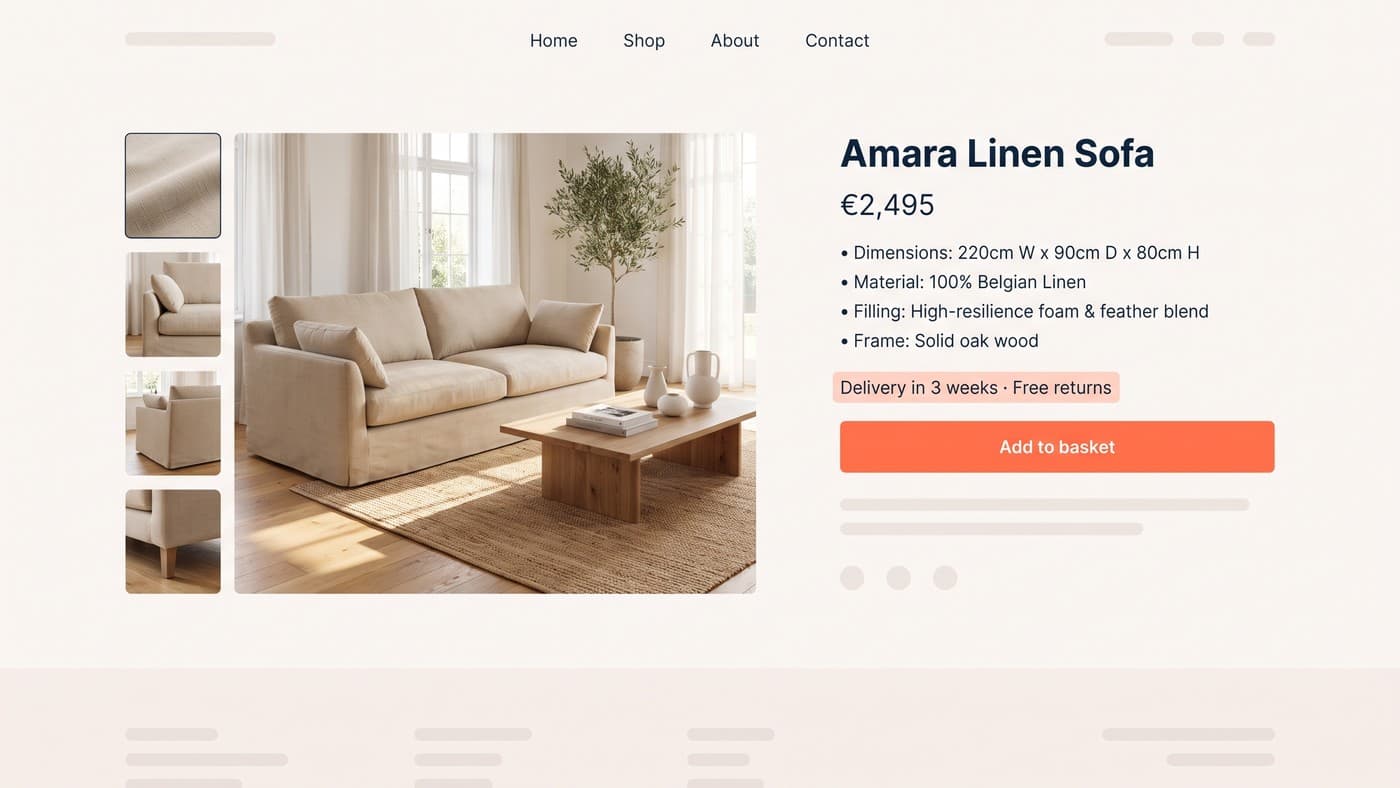
A product page is a general-purpose tool. It has to rank organically, serve comparison shoppers, returning customers and gift buyers, carry full specifications and reviews, and slot into your template system. A cold visitor from a problem-led ad arrives mid-conversation: they clicked a promise about a specific outcome, and the product page greets them with a product name and a gallery, as if they had searched for it by name. The gap between what the ad promised and what the page opens with is where paid conversion quietly dies.
Message match is mundane in practice: the lander’s headline restates the ad’s promise in nearly the same words, the first image continues the ad’s visual, and the first piece of proof supports the claim the ad made. Visitors decide within a second or two whether the click worked, and agreement between ad and page is what that second is checking.
The gap is measurable. On one store’s cold prospecting campaign, the product page converted paid clicks at 1.1%; a purpose-built lander for the same product, opening with the ad’s own promise, converted at 1.4%, a 27% relative lift at 96% confidence. Nothing about the product changed. The page just stopped starting the conversation over.
When a lander beats the PDP, and when it does not
Landers earn their keep on cold traffic and problem-led angles: prospecting campaigns, new-audience tests, anything where the visitor has never heard of you and clicked an idea rather than a product name. They are usually wasted on brand-term search and warm retargeting, where the visitor already knows the product and the product page’s completeness is a feature. Send returning shoppers to the real page; send strangers to the conversation they started.
There is also a maintenance honesty test: a lander per angle is worth building only if someone will keep it true. An out-of-date lander promising an offer that ended converts worse than the product page it replaced, and burns trust on the way down. Somewhere in the middle sit non-brand search terms, where intent is high but familiarity is low; test those rather than assuming either answer.
The decision is also budget-shaped. A store spending a few hundred pounds a month on ads will not recoup a lander programme quickly; a store spending five figures is leaving its largest cost line pointed at a page that was never briefed on the job. The higher the spend, the more expensive message mismatch becomes, and the faster a lander pays for itself.
Anatomy of a lander that converts
The structure that keeps testing well is boringly consistent:
- A headline that restates the ad’s promise, close enough that a visitor could believe the click worked. This is message match, and it is the whole point.
- One product, or one bundle. A lander that offers a browsing experience is a slow homepage.
- The objection stack: the three or four doubts this audience actually has, each answered in order, with evidence rather than adjectives.
- Proof beside the claim it supports: the review, the customer photo or the stat sits next to the promise, not in a carousel at the bottom.
- Delivery, returns and total cost stated before the button asks for the click.
- One call to action, repeated. Navigation, footers and cross-sells are exits, and a paid visitor who leaves the path rarely rejoins it.
Building landers on Shopify
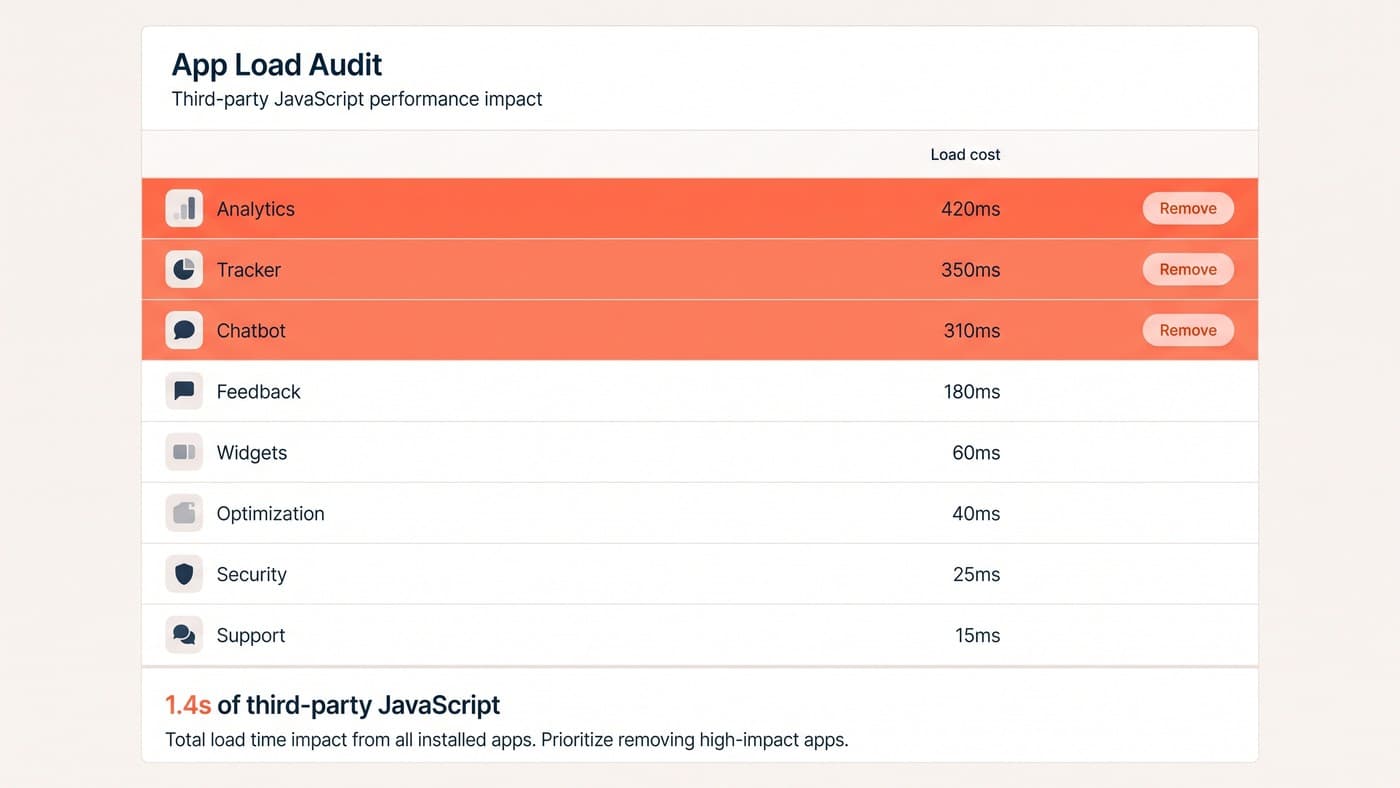
Shopify gives you three honest options. Theme sections and templates: a lander template built in the theme, fastest to load, most maintainable, the best default. Page builder apps: faster for a marketing team to iterate, at the cost of app weight and often a real speed penalty, the same trade our Shopify app audit prices in milliseconds. Or headless landers on a subdomain, for teams with standing engineering capacity. Most stores should start with theme templates and graduate only when iteration speed genuinely becomes the constraint.
Whichever route you take, keep the lander inside the store’s analytics and testing setup from day one; a lander living outside your measurement is a black box you are paying to fill. And hold it to the same speed bar as the store: paid clicks are the most expensive traffic you own, and a page-builder lander that takes four seconds to render is quietly refunding your ad budget to nobody. The SEO worry, that landers cannibalise the product page, is solved with a noindex tag rather than by not building them: the product page stays the page search engines rank, and the lander stays the page ads pay for.
The funnel maths, and testing them
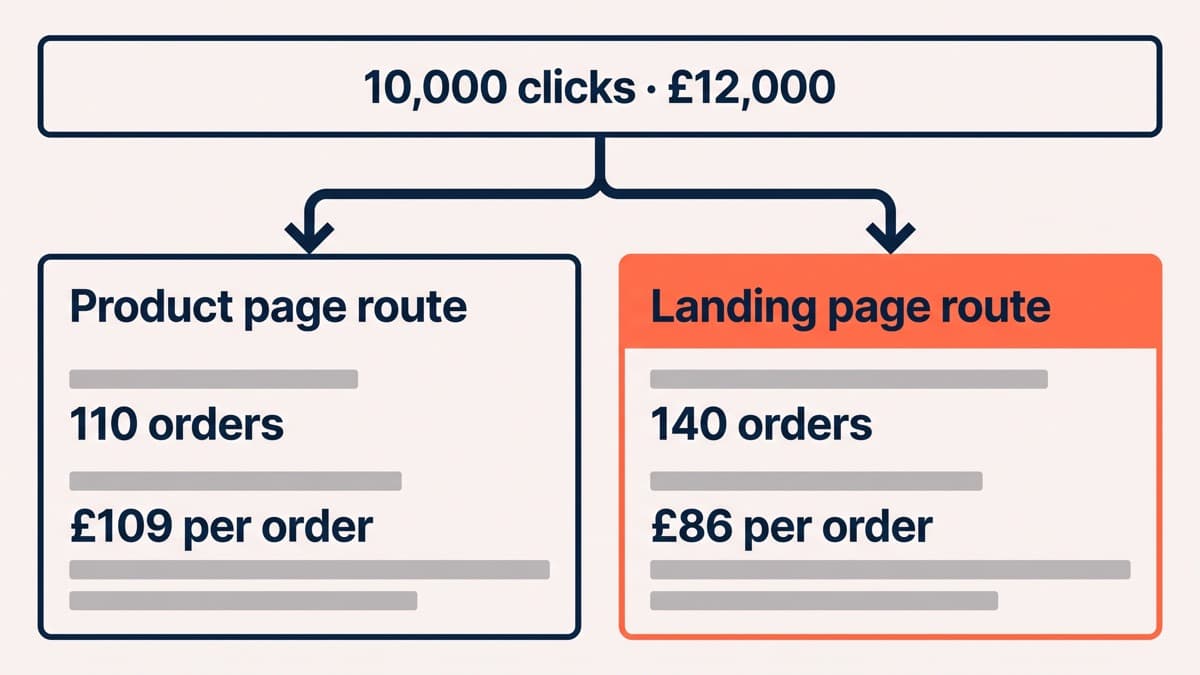
Run the arithmetic on your own campaign. At £1.20 a click, 10,000 clicks cost £12,000; at the product page’s 1.1% that is 110 orders at £109 each, and at the lander’s 1.4% it is 140 orders at £86 each. Same spend, same product, 27% more orders. Run the same sums before building anything, with your own click cost and baseline, because they also tell you what a lander programme is worth paying for. This is why lander work usually outranks another creative refresh in a paid account: the ad was never the only thing deciding.
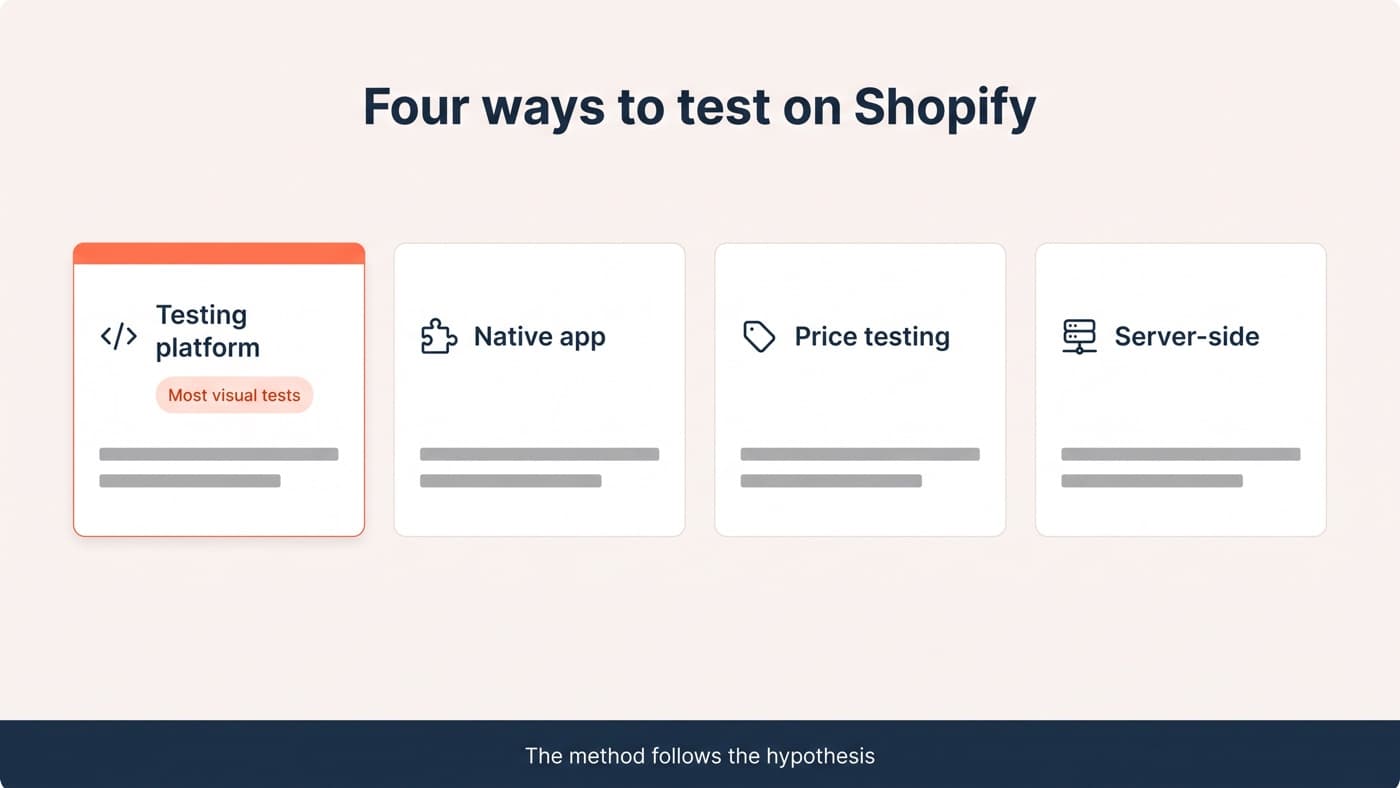
Landers are also the best testing real estate you own: traffic concentrates on one page with one intent, so experiments resolve faster than the same test diluted across a template. A headline test that resolves in two weeks on concentrated paid traffic could take two months spread across every product page. Headline angles, objection order and offer framing are all cheap, high-signal tests, and the discipline for running them without corrupting the numbers is the same as anywhere on the store, covered in our Shopify A/B testing guide.
If your paid traffic still lands on general-purpose pages, a lander programme, the template, the structure and the testing loop around it, is one of the highest-yield builds a store can commission, and it is bread-and-butter Shopify development work. To talk through what your own funnel numbers say it would be worth, get in touch.