Conversion rate gets the attention, but average order value is the quiet half of revenue per visitor, and it is often the cheaper half to move. The nine tactics below are ordered by how they have held up under real tests, because roughly half of what the upsell apps promise does not survive contact with a control group.
Why AOV is the underrated half of revenue
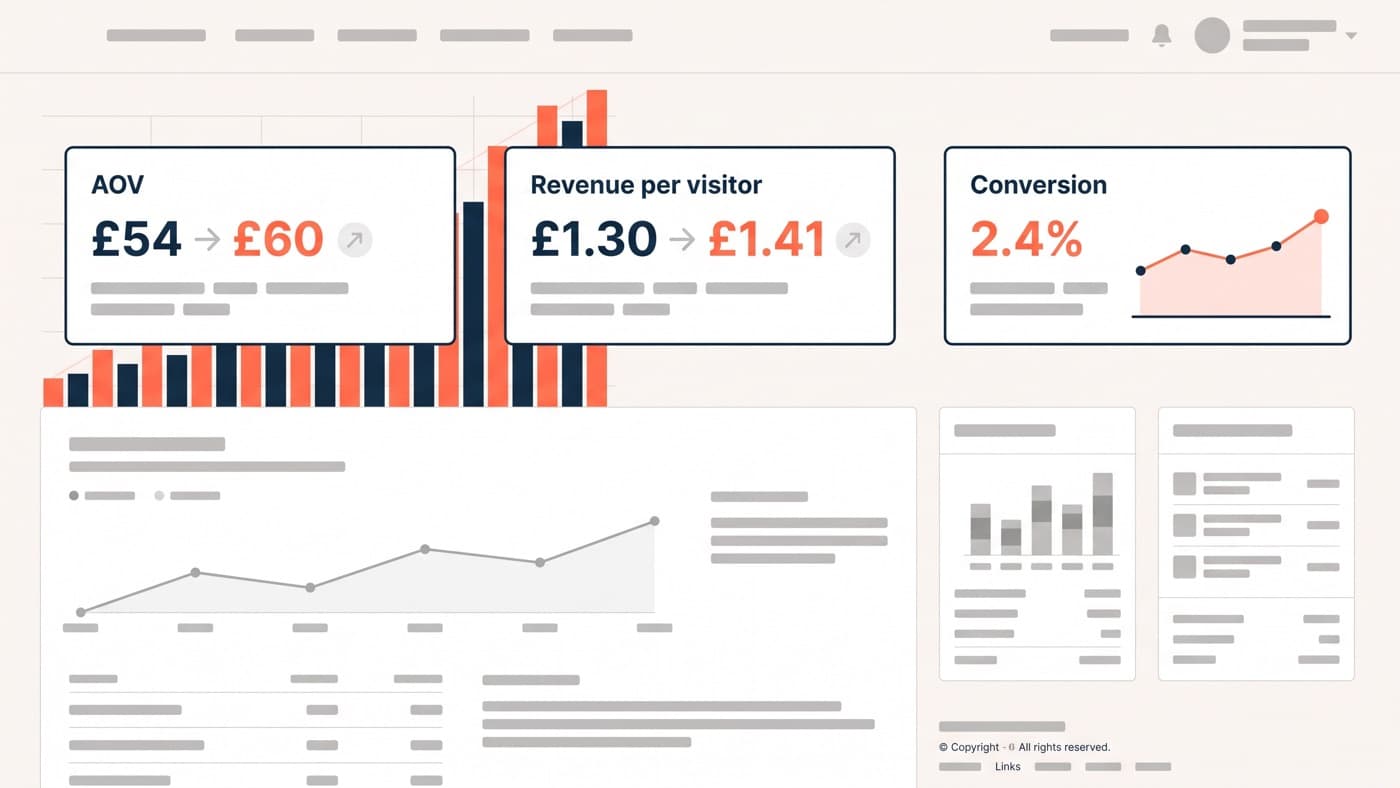
The arithmetic first. A store converting 2.4% of visitors at a £54 average order makes about £1.30 per visitor. Lift conversion 10% or lift AOV 10% and you earn the same extra thirteen pence, but the AOV lift needs no new traffic, no faster site and no redesign. It needs orders that already exist to grow slightly.
The catch, and the reason this article keeps returning to one referee metric, is that AOV is easy to move dishonestly. Interrupt shoppers hard enough and AOV rises while conversion falls, which is a pay cut dressed as a raise. Revenue per visitor settles every dispute in what follows.
One calibration note: there is no universal good AOV. A store selling £12 consumables and a store selling £400 furniture have nothing to say to each other on this metric. Benchmark against your own trailing quarter, and treat every tactic below as a way to move that line without bruising conversion.
Thresholds and shipping
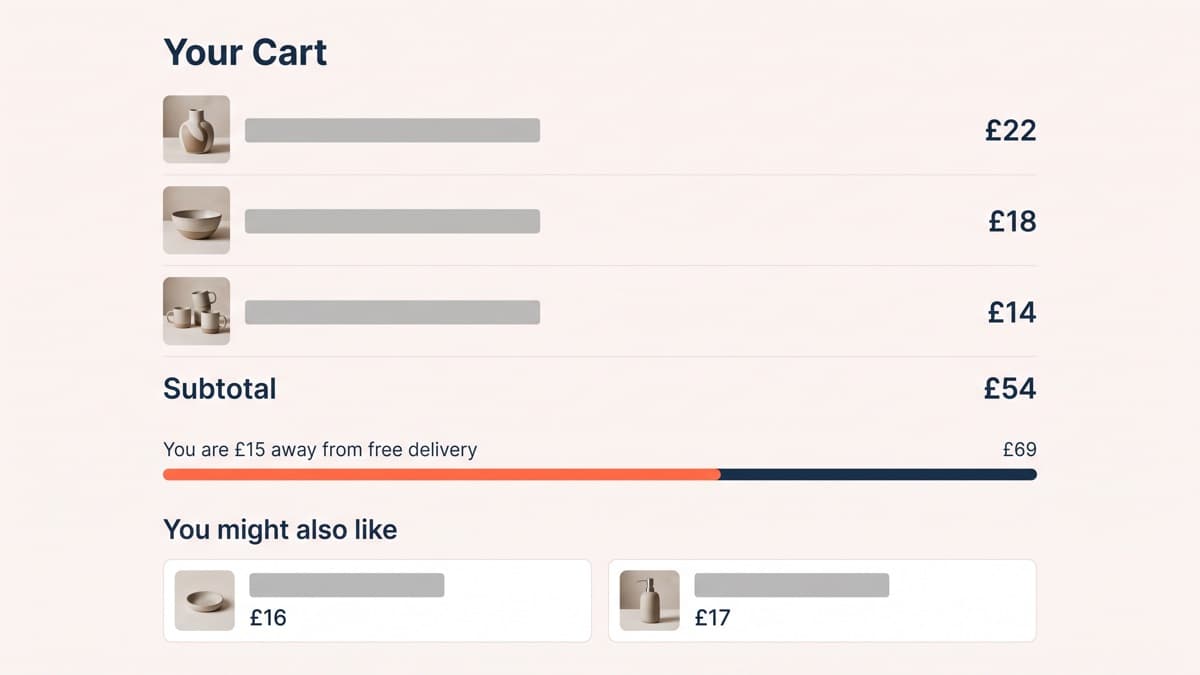
The free-shipping threshold is the most reliable AOV lever in our archive when it is set with restraint: 15 to 30% above current AOV. At a £54 average order, £69 works; £99 is a target nobody stretches for. In a typical test of the pattern, AOV rose 11%, conversion dipped 2% without reaching significance, and revenue per visitor rose 9%.
The threshold earns its keep only when shoppers can see progress toward it, which is why the cart-drawer line, you are £15 away from free delivery with a bar underneath it, outperforms a threshold mentioned only in the shipping policy. And thresholds stack: a soft second target above the first, such as a gift at £100, gives already-qualified baskets another reason to grow. Test the second target; ship the first.
The backfire mode is a threshold set from ambition rather than data. Set at nearly double the average order, the message stops reading as an invitation and starts reading as a reproach, and shoppers who cannot reach it are reminded on every visit that delivery costs extra. A target only works while it feels hittable.
Bundling and offers
Bundles work when they solve a job and fail when they read as inventory management. The routine, the starter kit, the refill set, bundles with an obvious logic, earn attach rates that clearance-shaped bundles never see. Price the bundle at a visible saving, but keep the components buyable alone; a bundle that removes choice tests as a loser far more often than one that adds a shortcut. A pantry client’s three-item routine bundle, priced at a visible 12% saving, lifted AOV 7% with conversion flat; the clearance-shaped bundle tested the quarter before had moved nothing.
Volume pricing belongs on consumables, where a two-pack discount matches how the product is actually used, and feels absurd on considered one-off purchases. Range anchoring is the quiet third tactic: a premium option placed above the bestseller lifts the mid option’s share without the premium needing to sell at all. It backfires on thin catalogues, where the anchor reads as exactly the upsell it is. The test-or-ship verdict differs across this group: thresholds and anchors deserve a controlled test, while a two-pack on consumables is usually safe to simply ship.
The three moments: cart, checkout, post-purchase
The last three tactics are about placement rather than offer, because the same cross-sell performs completely differently depending on when it interrupts.
- Cart drawer: cross-sell genuine complements under a third of the basket’s value. Batteries with the device, filters with the machine. Substitutes and bestseller carousels here test flat or negative.
- Checkout: keep add-ons small, cheap and frictionless, such as shipping protection and gift wrap. Take rates are modest but the marginal cost is near zero. Watch completion like a hawk; anything that costs completion loses more than it adds.
- Post-purchase: the highest-performing moment per unit of risk, because the order already exists and conversion cannot be harmed by definition. One-tap offers immediately after payment see 4 to 8% take rates in our tests.
Ordering matters more than most app defaults admit: the post-purchase moment should carry your boldest offer and checkout the most conservative one, which is roughly the opposite of how the average upsell app arrives configured. The take-rate numbers explain why, since interrupting before payment risks the order to grow it, and interrupting after risks nothing at all.
What backfires at every moment is the substitute. Showing a cheaper alternative mid-checkout is the one pattern in this article that has never won a test for us, because it reopens a decision the shopper had already closed.
Measure with revenue per visitor, not AOV alone
The classic failure looks like success: AOV up 9%, screenshots in the team channel, and conversion quietly down 6%, which nets out negative. Interruptive upsells, forced bundles and aggressive minimums all produce this shape. Revenue per visitor is the referee, and any AOV tactic that cannot win on RPV did not win.
The subtler trap is celebrating a flat. An AOV tactic that moves nothing still costs something: another interruption in the flow, another script in the cart drawer, another surface to maintain. Our default is to remove flats rather than keep them, because an interface only earns its complexity with evidence.
AOV is also statistically noisy in a way conversion is not: one corporate bulk order can swing a week, so AOV tests need longer runs, trimmed means or medians, and more patience than the same store’s conversion tests. The contested tactics here, thresholds, cross-sell placement and anchoring, belong in your test backlog rather than shipped on faith, and anything touching the checkout flow should respect the completion disciplines in our checkout UX guide.
The build half matters too. Cart drawers, checkout extensions and post-purchase flows are engineering surfaces, and a cross-sell that adds half a second of load costs more in speed than it adds in basket, which is why Shopify development discipline and AOV work travel together. Start with the threshold, referee everything with revenue per visitor, and treat every app promise as a hypothesis until a control group agrees. AOV sits beside conversion in the same programme, and the Shopify CRO guide shows where.