CRO audit
CRO audits that find where your store leaks revenue
A CRO audit that starts with your data, not a template: analytics reconciled against real orders, sessions watched, speed measured on real phones, and every finding shipped as a fix or a test-ready hypothesis.
Start free: one high-traffic template of your store torn down properly, with two or three test ideas attached, inside a week. Commission the full audit when the sample has earned it. Either way, the findings are yours.
- Free audit: 2–3 test ideas in 3–5 working days
- Every finding tied to your own data
- No obligation, no hard sell
Audited in your stack
The problem
Why most CRO audits are not worth reading
Nearly every agency gives audits away, so most audits are built to sell rather than to diagnose. Hand your store to a template-filler and the same four failures arrive in the PDF.
The sales deck in disguise
Ten generic screenshots, a traffic-light severity scheme and a pitch on the last slide. The test it always fails: it could have been produced without access to your data.
Findings that fit any store
“Improve your call-to-action visibility” is not a finding, it is a horoscope. A real finding names numbers only your analytics could have produced.
No healthy findings
A report where everything is broken means nobody actually looked. What an audit did not find, the parts of your store that work, is half of its value.
Forty tips, zero priorities
An undifferentiated list hands the hard part, deciding, back to you as homework. Prioritisation is the deliverable; the findings are just its inputs.
We publish what a real audit contains and hold our own free one to that standard: every finding evidenced from your data, labelled a fix or a hypothesis, and ranked by what it is worth.
The diagnosis before anyone prescribes.

Free vs full
Two audits. One standard.
The free audit is a small sample of the full one, held to the same rule: nothing goes in the report that your own data cannot prove.
What we build
What the full audit examines
Analytics and funnel
- Analytics reconciled against back-office orders first, because tracking that undercounts revenue corrupts every decision downstream of it
- Conversion split by device, channel and landing page
- The funnel broken into steps, with the largest leak named and sized in percentage points
Behaviour research
- Session recordings and heatmaps on the highest-traffic templates
- Site-search queries read as customers typing what they want
- Checkout abandonment watched session by session, not inferred from a funnel chart
Speed and technical
- Core Web Vitals measured on a mid-range phone over mobile data, not an office laptop on fibre
- Every app and third-party script costed in milliseconds as well as pounds
- Broken states, dead ends and recovery paths: declined payments, out-of-stock pages, failed searches
The prioritised backlog
- Every finding labelled a fix (no control group needed) or a test-ready hypothesis
- Expected effect sized against your traffic and baseline, so nothing is prescribed that your store cannot measure
- Ordered by expected revenue impact against build effort, so testing can start the week after the readout
A sample finding, as it ships
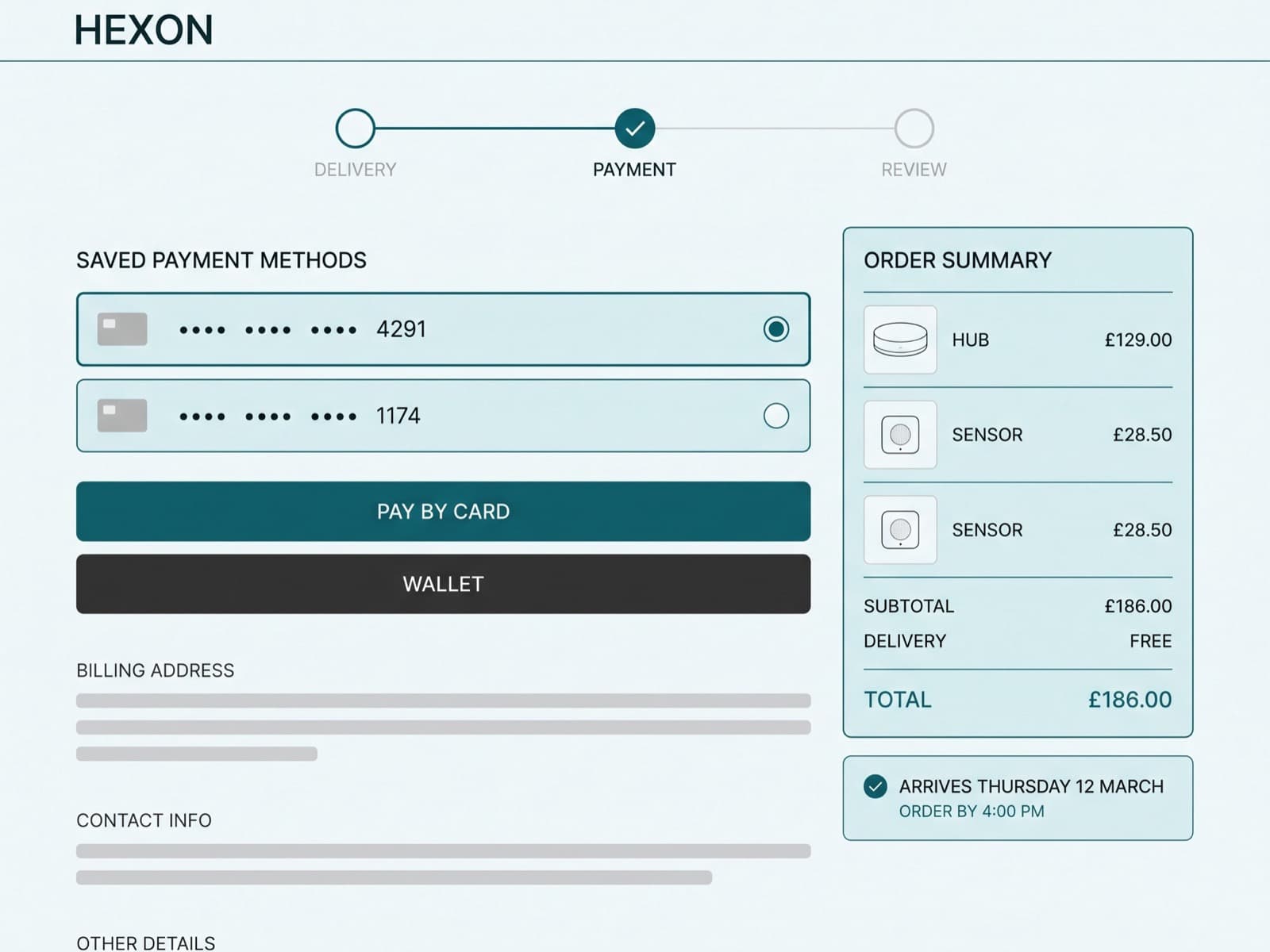
- Observation: session recordings show mobile visitors leaving the payment step to open the delivery FAQ, and most never coming back
- Hypothesis: visitors abandon to answer a question the page should answer; a dated delivery estimate inside checkout removes the exit
- Expected test: show a delivery date under the order summary and measure checkout completion. The same pattern on its product pages took a homeware store from 2.1% to 2.4% conversion, a 14% relative lift at 96% confidence
Why us
Free audit, full audit, or full programme
| Engagement | What you get | Cost and timeline |
|---|---|---|
| Free CRO audit | One high-traffic template, usually the product page or checkout, taken apart against your live store: five to eight evidenced findings and 2–3 test-ready ideas. | Free, no obligation. Delivered as a short annotated document in 3–5 working days. |
| Full CRO audit | The complete diagnosis: analytics reconciled to orders, funnel and device breakdowns, session research, speed on real devices, every template. 25–40 findings, each one a fix or a hypothesis, ranked by expected revenue impact. | Quoted against store size and research depth, fixed and itemised before work starts, delivered in 2–4 weeks. |
| Full CRO programme | The audit becomes month one: strategy, test builds, QA and monthly readouts, ongoing, so the backlog gets tested rather than shelved. | A monthly fee, quoted against store size and test cadence. Keep strategy in-house and buy standing build capacity by the month instead, or single test builds one at a time. |
How it runs
How the full audit runs
Two to four weeks from access to readout, and most of it is data collection, because that is what separates a diagnosis from a deck.
- 1
Access & reconciliation
Read-only access to analytics, Search Console and your recording tool, plus a sample of back-office orders. The first job is checking the analytics against reality; if tracking undercounts revenue, that is flagged before anything else is believed.
- Read-only access only
- Analytics reconciled against orders
- Tracking defects flagged first
- 2
Data collection
Watching and measuring across a full traffic cycle: funnel and device splits, session recordings on the highest-traffic templates, site-search queries, and speed on a mid-range phone over mobile data.
- Full weekly traffic cycle observed
- Sessions watched, not skimmed
- Speed measured on real devices
- 3
Findings & prioritisation
Every finding becomes a fix, a defect nobody needs a control group for, or a hypothesis with the evidence and expected effect attached. The backlog is ranked by expected revenue impact against build effort.
- Fix or hypothesis, never a vague tip
- Expected effect sized per item
- A ranked backlog, not a list
- 4
Readout & handoff
A working session, not a PDF drop: we walk the findings, take the pushback, and hand over a backlog your team can run anywhere, including without us.
- Live walkthrough call
- Questions answered on the spot
- The backlog is yours to keep
What every audit includes.
Reconciliation first
Your analytics checked against real orders, because every number downstream inherits it.
Funnel breakdowns
Every step from landing to purchase, with the largest leak named and sized.
Real-device speed
Measured on a mid-range phone over mobile data, not an office laptop on fibre.
Checkout teardown
The highest-stakes template audited field by field, against session evidence.
Ranked by revenue
Findings ordered by expected impact and effort, not by how easy they were to spot.
Test-ready backlog
Every hypothesis arrives sized and buildable, ready for the first month of testing.

They told us not to redesign our navigation. The test they ran killed our own pet idea, and saved us six figures.
SSteven ParkGrano & Sale Reviewed by Zahidul IslamCTO & Experimentation Lead
The answers to your questions.
One high-traffic template, usually the product page or checkout, torn down properly: five to eight findings evidenced from your live store, with two or three test-ready ideas attached, delivered in 3–5 working days. It is a genuine sample of the full audit held to the same standard, not a brochure, and there is no obligation attached to it.
Two to four weeks, because most of that time is data collection: letting a full traffic cycle pass, watching enough sessions to see patterns rather than anecdotes, and reconciling analytics against real orders. An audit that arrives 48 hours after access was granted is a template with your screenshots in it, and we refuse to produce one.
The single-template audit is free, and the full audit is quoted once we have seen the store. What moves the number is how much primary research the audit needs rather than any rate card: session analysis and order reconciliation cost real hours; annotated screenshots do not. The price is fixed and itemised before work starts, so it cannot drift mid-audit, and there is no lock-in either way: the audit is a piece of work, not the first month of a retainer.
The backlog is yours, whoever runs it. Some clients take it to their in-house team, some to another agency, and some ask us to test it, one build at a time, on standing monthly build capacity, or as a full-service programme with the strategy included. Whichever shape fits, it is quoted after the readout, not before it, and no retainer is pitched on the readout call, ever.
Yes. The method reads from your analytics, your sessions and your customers, not from the platform, so WooCommerce, Magento, BigCommerce, headless and custom carts are all auditable. The platform only changes the fix list: what is a theme setting on Shopify may be a template edit elsewhere. Shopify and Shopify Plus are simply the stores we see most.
Almost certainly, because an audit is not a test programme. Below roughly 1,000 orders a month the backlog leans towards fixes and research rather than A/B tests, and the audit says so honestly instead of prescribing experiments your traffic cannot support.

Find out where your store leaks
Send us your store and we will send back the free audit: one template read properly, two or three test ideas attached, no obligation and no hard sell. We reply to all inquiries within one working day.
Claim your free CRO audit ↗