Urgency works. That much is settled and fairly uninteresting. The only question worth asking about your own is whether it is true, because a fake deadline teaches customers to ignore every deadline you set afterwards, while true urgency is nothing more exotic than useful information delivered on time.
This article owns the honesty test and the inventory of urgency a store already has and mostly fails to say out loud. The taxonomy of manipulative patterns, and the regulatory position stated jurisdiction by jurisdiction, belong to our article on dark patterns and are not restated here.
The honesty test
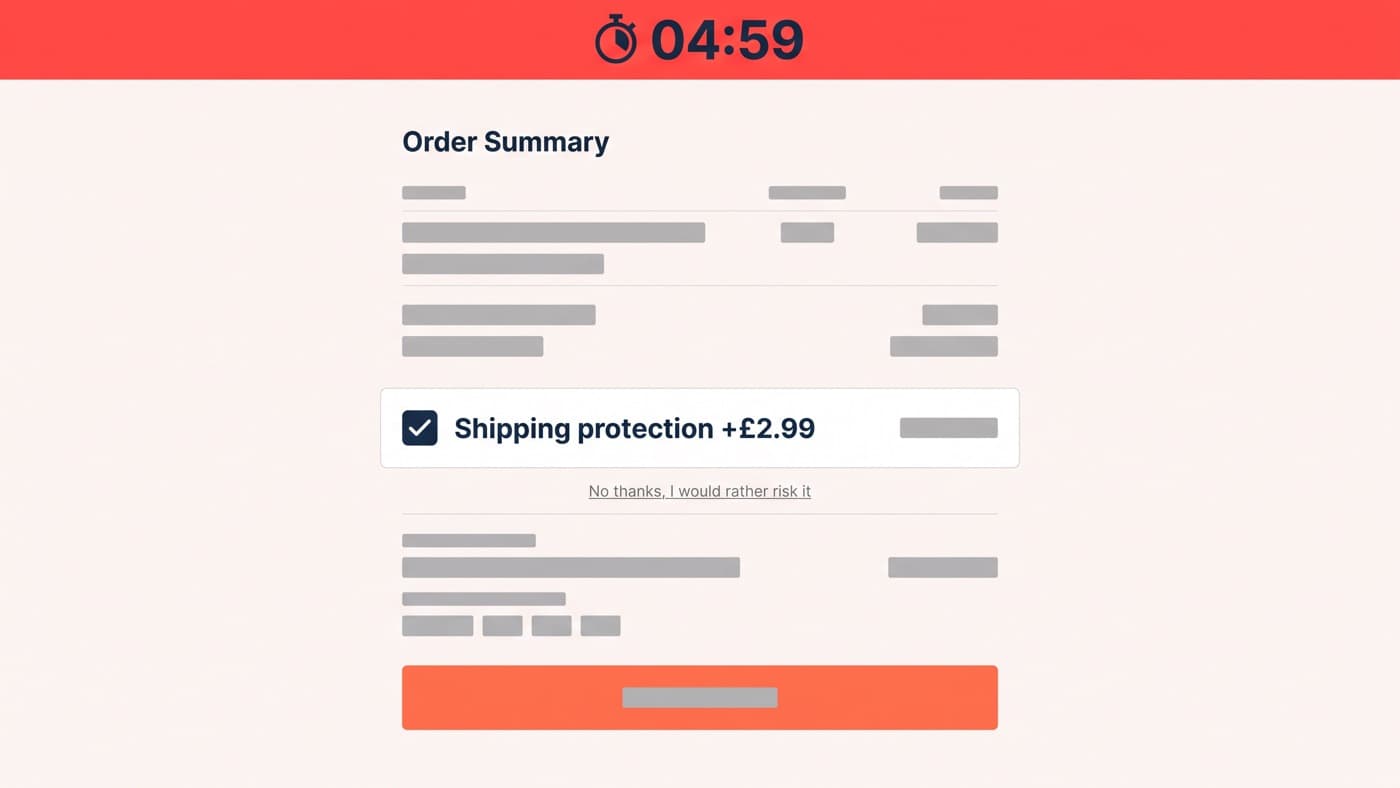
One question settles almost every case: if the shopper could see the system behind the message, would the message still work? A dated shipping cutoff survives that inspection easily, because knowing the van leaves at four is the reason somebody buys at half past three instead of on Thursday. A countdown that restarts on page reload does not survive it at all, and the reason is not squeamishness. It is that the tactic depends on the shopper not understanding it, which makes every future claim you make cheaper.
The blunter version is the one to use in a review meeting. Point at the message and ask what would have to be true for it to be accurate, then ask somebody to open the admin and show you the field it reads from. A stock counter nobody can trace to an inventory record has just failed. So has a Selling fast label that turns out to be triggered by page views, and so has an offer that ends tonight and has ended every night since March.
That last example is not hypothetical: in May 2026 the High Court confirmed that one mattress retailer’s countdown timers, its continuously renewed limited-time discounts and its High Demand labels had broken UK consumer law. The detail worth borrowing is the mechanic that made the label indefensible. It fired on view counts rather than on stock, and one product carried High Demand after 6,458 views in a day during which 7 units sold.
The urgency you already have
Most stores reach for a timer app because nobody has written down the deadlines they genuinely operate. There are usually five or six, and every one of them is more persuasive than anything an app can generate, because they are specific, checkable and about the shopper rather than about the sale.
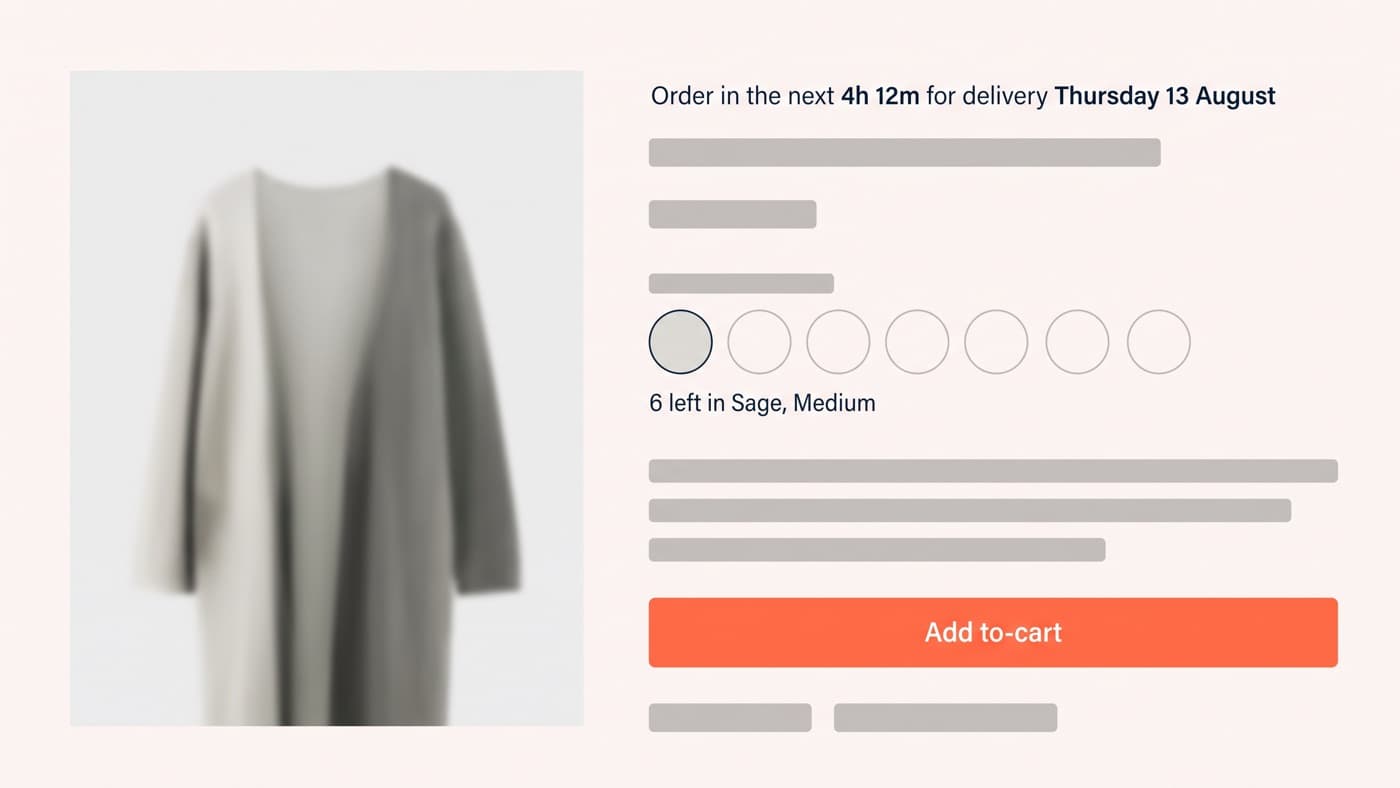
- The shipping cutoff: order within a stated window today and it goes out today, expressed as the date it arrives rather than as a courier collection time.
- Real stock, at variant level. Six left in one size is information; a permanent low stock badge across the catalogue is decoration.
- A dated promotion with a genuine end, meaning the price actually changes when the clock stops and does not reappear the next morning under a new name.
- Production and restock reality: made in batches, next run in September, back in stock on the 14th, waiting list open now.
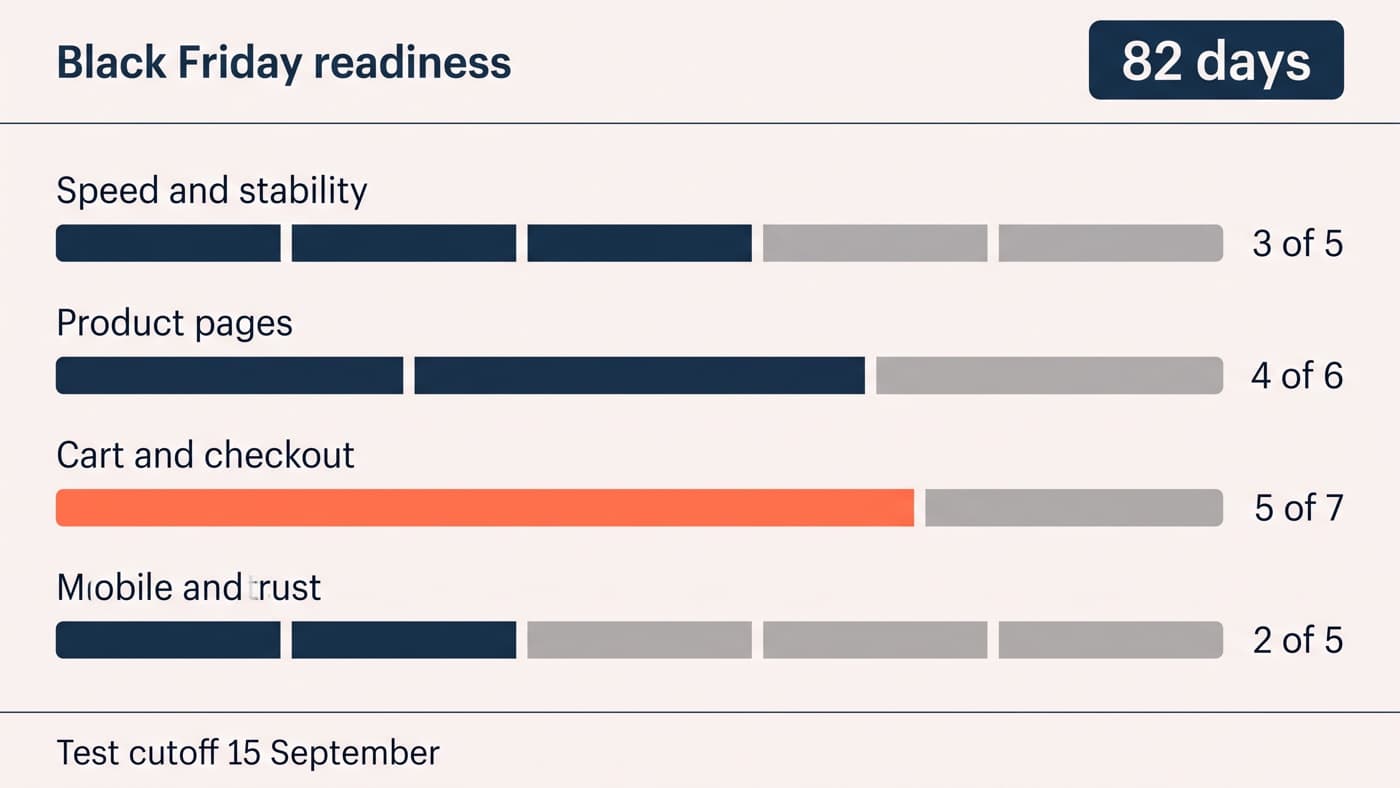
- Seasonal relevance, the most underused item in the set, because the deadline belongs to the event the shopper cares about rather than to your offer.
- Cart or slot reservations, but only where the reservation is real, as it is for ticketing, delivery windows and made-to-order production slots.
Notice what every entry shares. Each is a fact about your operation that the shopper cannot see and would want to know, which is the actual difference between urgency and pressure. One is disclosure and the other is theatre, and shoppers separate the two faster than most merchandising teams expect.
What the true version is worth, and the fake one costs
An outdoor retailer replaced a generic Selling fast banner with a dated cutoff line reading order in the next few hours for delivery on a named day, computed from the courier collection time and the customer’s own region. Conversion moved from 2.1% to 2.4%, a relative gain of 14% at 96% confidence, and revenue per visitor rose 11%. The banner it replaced had tested flat twice.
Real stock messaging behaved similarly once it was made rare. Showing the exact remaining count only below a threshold of 8 units lifted add-to-cart on the affected variants by 5% at 93% confidence, which is a modest result honestly reported. The version showing a low stock badge on 60% of the catalogue had produced nothing at all, because a signal that is always on is not a signal.
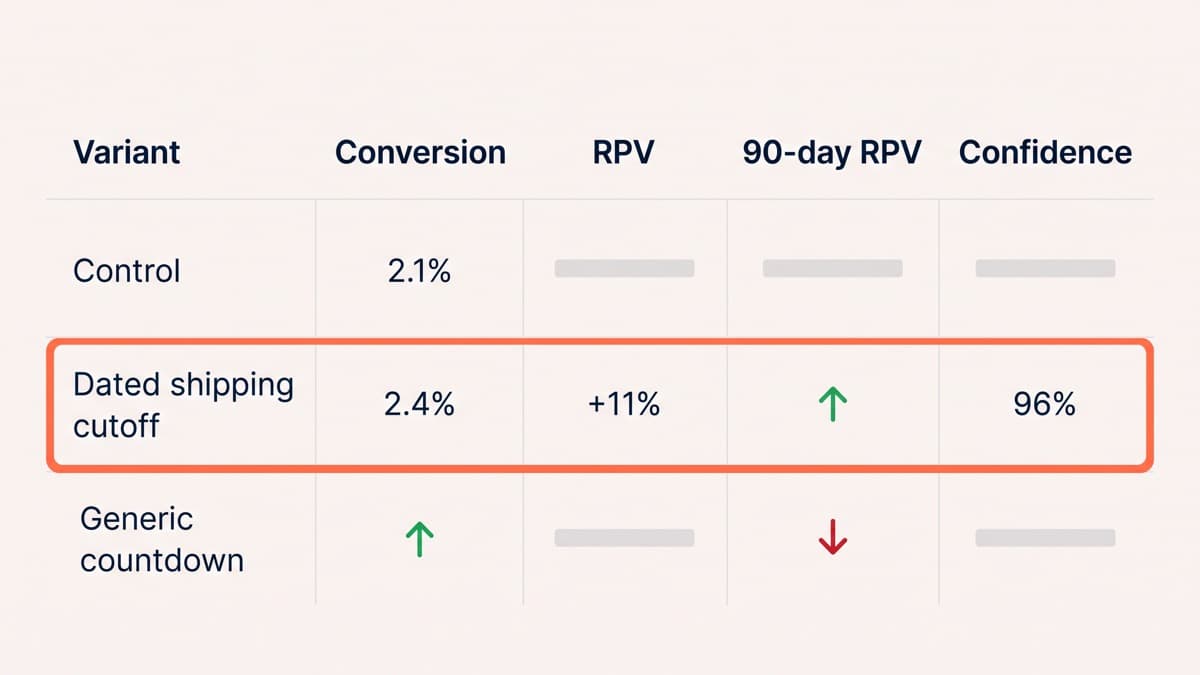
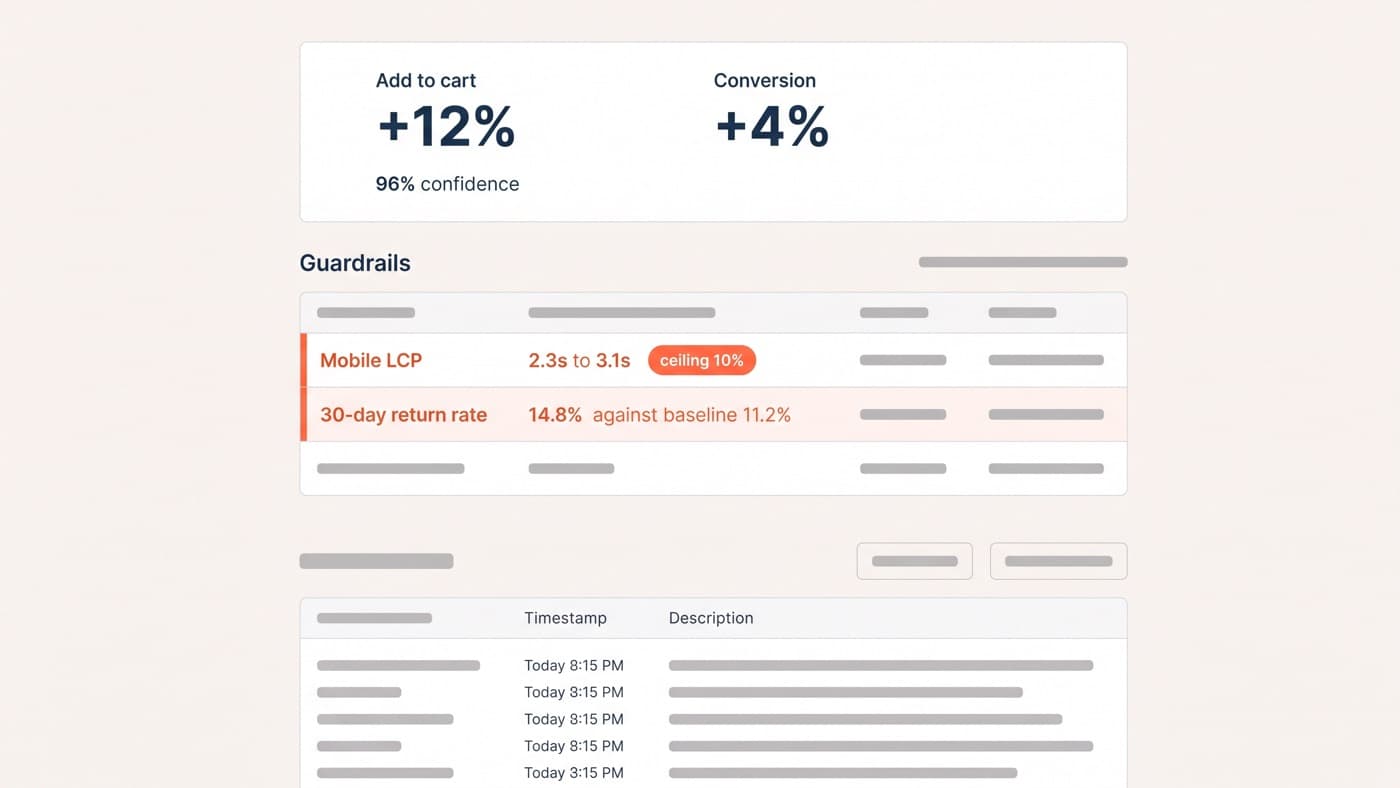
The fake version does not lose immediately, which is what makes it durable inside organisations. It wins the shallow metric, gets screenshotted, and returns the money later as refunds, support contacts and a repeat rate that drifts without an obvious cause. That pattern is only visible if you were already watching for it, which is the argument for attaching guardrail metrics to anything that touches deadlines or availability.
Building it so it stays true
True urgency is an engineering problem more than a copy one, and it fails in predictable places. Bind every claim to a source of truth: the inventory field for stock, the fulfilment calendar for cutoffs, the promotion record for end dates. Compute cutoffs in the customer’s timezone and against a real dispatch calendar that knows about weekends and bank holidays, because a message promising Tuesday delivery on the Friday of a long weekend is a lie told by a rounding error.
Then make the failure mode safe. If the stock figure is unavailable, the message should disappear rather than fall back to a default; if the promotion record has no end date, no countdown should render at all. Most fake urgency on real stores was never a decision, it was a default left in place after an integration broke, which is also why it survives so long: nobody chose it, so nobody owns removing it.
Seasonal peaks are where the discipline pays and where it usually slips, since a genuine last order date for Christmas delivery is the strongest honest urgency most stores will ever run and the one they publish latest. Planning it alongside the rest of the peak sequence, in the way the BFCM checklist sets out, turns it from a panic banner into a dated commitment the operations team has already agreed to.
Testing it without fooling yourself
Urgency is one of the most novelty-prone categories there is, because the first cohort to see a new banner reacts to its newness as much as to its content. Read these tests over a full purchase cycle rather than calling them in week one, keep the guardrails visible next to the primary metric, and be suspicious of any urgency win larger than about 15%, which in our experience usually means the variant changed something else as well.
Ask the same question of any partner running this work: not what urgency tactics they recommend, but which system each claim will read from and what happens to the message when that system is unavailable. A team that cannot answer the second half is describing a banner rather than a mechanism, and banners are how stores end up with a timer nobody can switch off. Honest deadlines are ordinary A/B testing work with a fact-checking step in front of it. If you are currently defending a countdown to somebody, the useful next step is finding out what it reads from.