Most ecommerce SEO advice is about publishing more. The decisions that actually compound are structural, they get made in the first fortnight of a build, and they are close to impossible to undo two years later without a redirect map nobody wants to own.
WordPress and WooCommerce give you enough rope here to do real damage, mostly by generating URLs faster than anyone notices.
Decide the URL structure once
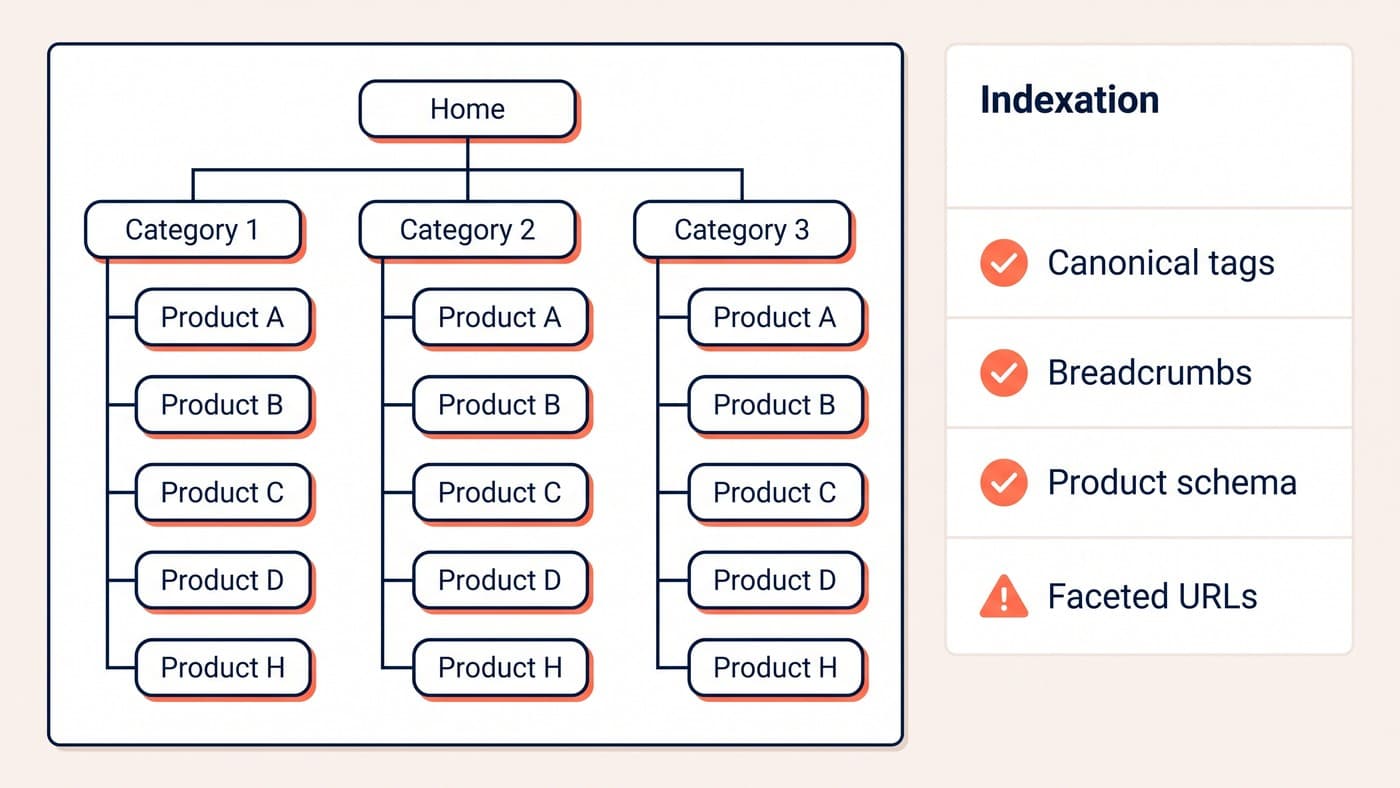
Flat product URLs — /product/blue-linen-shirt/ — are simple, stable and survive a product moving category. Nested URLs read more logically but break the moment merchandising moves something, and merchandising always moves something.
We default to flat for products and keep hierarchy in the category tree and the breadcrumbs, where it is expressed for humans and for crawlers without being welded into every product URL. Whatever you choose, choose before launch. Changing later means hundreds of redirects and a quarter of suppressed rankings.
Faceted navigation is where crawl budget goes to die
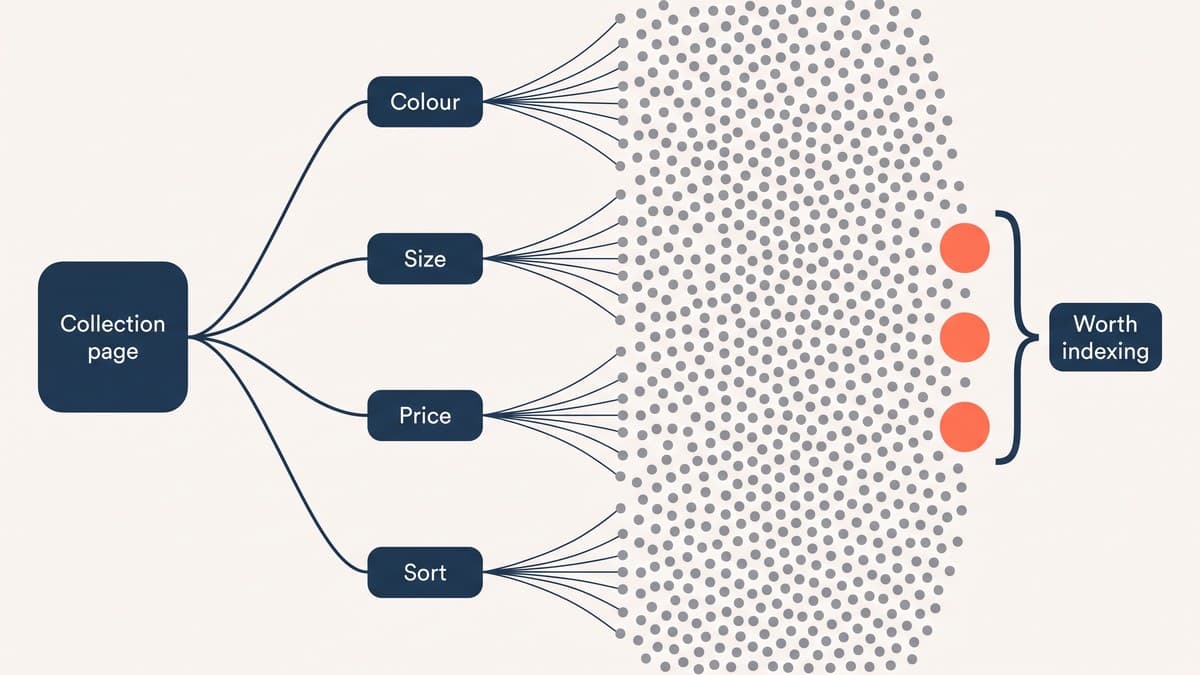
Filters are the most reliable way to turn 400 products into 40,000 URLs. Colour, size, price, sort order and page number combine into an effectively infinite space of near-identical pages, and a crawler will happily spend weeks in there instead of finding your new products.
Decide deliberately which filter combinations deserve to be indexable. Usually a small set has genuine search demand — "blue linen shirts" is a real query, "blue linen shirts sorted by price, page 4" is not. Index the first kind, canonicalise or block the rest, and make sure filters that should not be crawled are not emitting crawlable links.
Structured data, done once and properly
Product schema with accurate price and availability is the highest-value markup on an ecommerce site, because it feeds rich results and, increasingly, the answers assistants give when somebody asks about a product category.
The failure mode is markup that drifts out of sync with the page — a price in the schema that no longer matches the price on screen. Generate it from the same source as the rendered page, never by hand, and validate after any pricing change. Add breadcrumb markup while you are there; it is cheap and it improves how listings display.
Internal linking is architecture, not decoration
Most ecommerce sites have exactly two kinds of internal link: navigation and breadcrumbs. Both are templated, both point upward, and neither tells a crawler anything about which pages matter most.
The pages you most want to rank should be reachable in the fewest clicks from the home page, and should be linked to from the most places. If a high-margin category takes four clicks to reach and is linked only from a mega-menu, you have told search engines it is a minor page — regardless of what the business thinks.
Editorial content is the cheapest way to fix this, which is why buying guides earn their place. A guide that genuinely helps someone choose, and links naturally to the three categories it discusses, is doing structural work as well as answering a question. That is also the content most likely to be quoted by an assistant summarising the category, because it reads as guidance rather than as inventory.
Audit this by clicking, not by reading a diagram. Start at the home page and try to reach your ten most valuable products the way a customer would. The pages that take longest to find are usually the ones underperforming in search, and the two facts are rarely a coincidence.
The structural checklist
Get these right early and ordinary content work compounds. Get them wrong and no amount of publishing rescues it:
- One canonical URL per product, decided before launch and never quietly changed.
- A deliberate indexation policy for filters, with the valuable combinations chosen explicitly.
- Product and breadcrumb schema generated from the page's own data.
- Category pages with genuine introductory copy, not a headline and a grid.
- Out-of-stock products kept live with alternatives, rather than deleted into a 404.
- A redirect map maintained as part of merchandising, not written in a panic at launch.
Write for the question, not the keyword
Category copy that exists to hold keywords reads like it, and it increasingly fails on both fronts: shoppers skip it and answer engines have plenty of better sources to quote. Copy that answers the question a buyer arrived with — what is the difference between these two materials, which one suits a small kitchen — earns the position honestly.
None of this is quick to show results, and that is worth setting expectations about internally. Architecture work pays back over quarters rather than weeks, which makes it the first thing cut when somebody wants a number to move this month — and the thing everybody wishes had been done properly when the replatform arrives two years later.
Finally, treat migrations as the highest-risk event in this whole area. Most of the catastrophic ranking losses we are asked to diagnose trace back to a replatform where redirects were mapped from a spreadsheet of top pages rather than from a full crawl of what actually existed. Crawl the old site before it goes away — afterwards, the information is simply gone.
One practical warning: do not let an SEO plugin's green lights stand in for judgement. They check that a keyword appears, not whether the page answers anything, and optimising towards them produces exactly the thin category copy that stopped working years ago.
Structure and content pull in the same direction here, which is convenient. A page with a clean canonical URL, accurate schema and a heading that matches the question it answers is easy for a crawler to file and easy for a model to quote. Neither trick works without the other.
The practical order is the one above: fix the architecture first, because it is expensive later, then write the pages that deserve the position. A brilliant guide on a URL that changes every time merchandising reorganises the catalogue will never accumulate anything.
That is also what gets a page cited rather than merely ranked, which is where a growing share of discovery now happens. The structural work above and the speed work are the foundations; the copy is what people and models actually quote. If you want an audit of how yours is structured, our WordPress development team can do that — get in touch.