A headless rebuild, +19% average order value
- Average order value
- +19%
- from £1,240 to £1,476
- Revenue per session
- +34%
- from £8.90 to £11.93
- Mobile LCP, product pages
- 2.1s
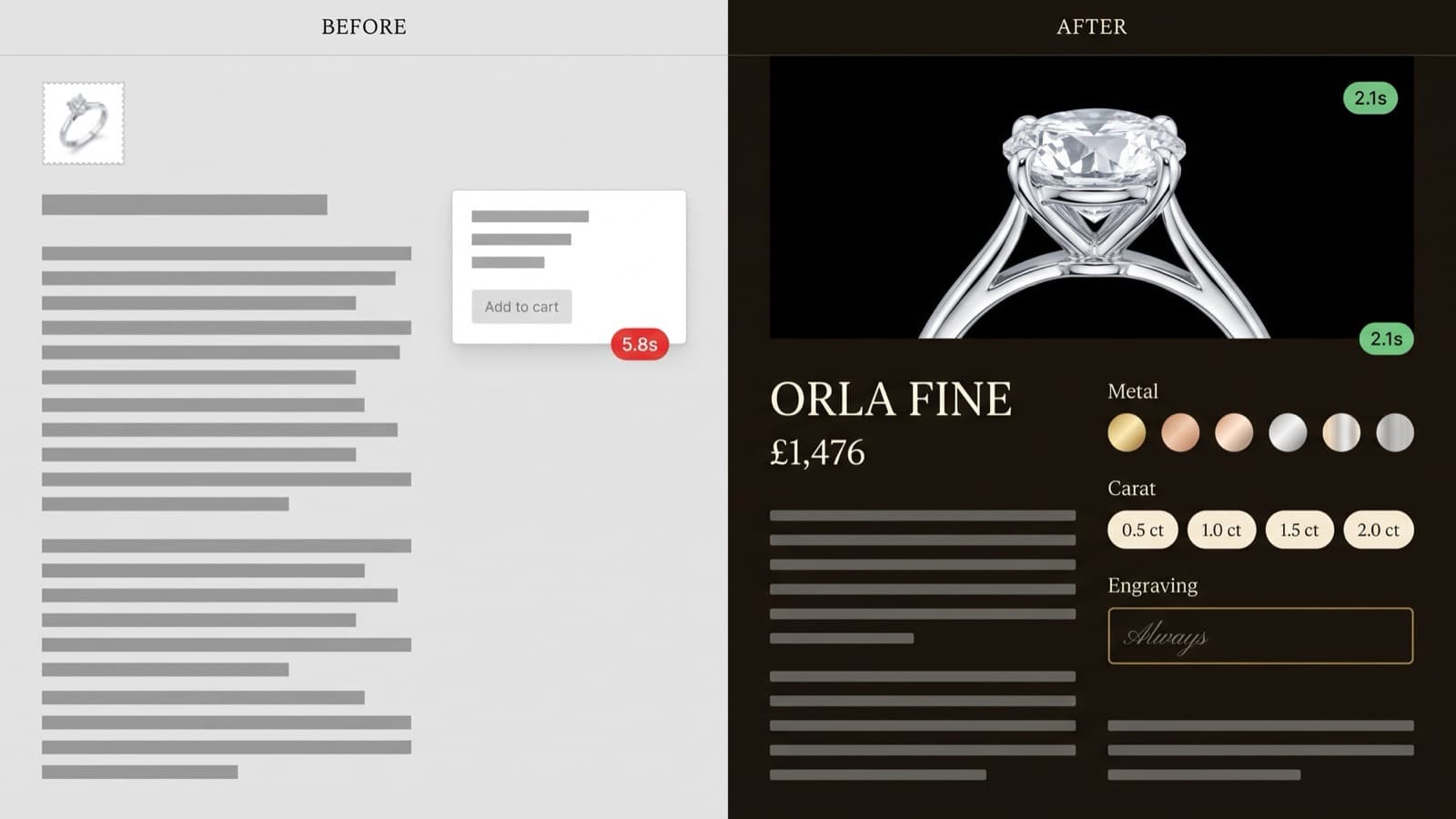
- from 5.8s
- Atelier appointments booked
- +61%
- from 44 to 71 a month
The brief
What they came to us with
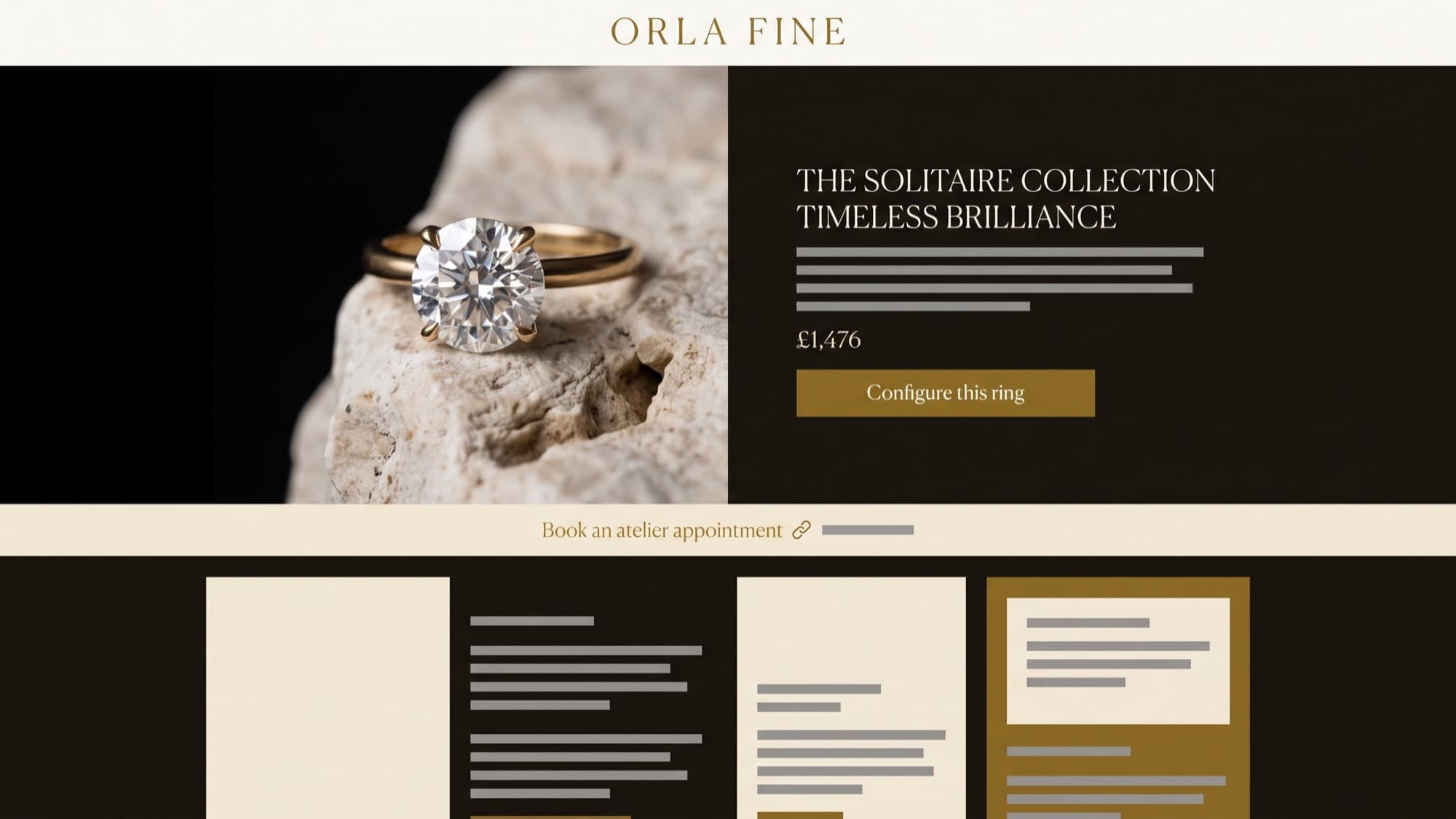
Orla Fine makes engagement rings, signets and heirloom commissions to order. Most pieces are configured before they are made — metal, stone, carat, ring size, and an engraving that is often the whole reason someone bought. The average order is over a thousand pounds and the average decision takes eleven days and four sessions.
The storefront did not behave like it knew that. Configuration lived in a modal that reloaded the page on every option change, so choosing platinum over gold cost three seconds and a scroll position. Product photography — the only reason anyone trusts a stone they cannot hold — shipped as full-resolution JPEGs, 6.4MB on the heaviest page. Mobile LCP was 5.8 seconds. Half the traffic is mobile, and most of it arrives from Instagram at eleven at night.
The founders assumed the problem was conversion rate and asked for a CRO retainer. We told them their traffic was far too thin to run a normal testing programme and that the first eight weeks should be a rebuild, not an experiment. That was the harder sell and the right one.
Constraints
- Roughly 38,000 sessions and 310 orders a month. Any test worth reading needs six to ten weeks, not six days — the roadmap had to be short, sequential and expensive-to-be-wrong.
- Imagery is the product. Sixteen shots per piece, macro detail on stone and hallmark, and no appetite for compressing them into something that looks like costume jewellery.
- Made-to-order lead times of four to seven weeks. Nothing on the page could imply next-day delivery, and every change had to survive the "when will it arrive" question honestly.
- No discounting, ever. Codes, urgency banners and countdowns were off the table — the usual AOV levers simply did not exist here.
The approach
How we worked the problem
Two phases. Rebuild the storefront so the considered purchase is actually pleasant, then test slowly and honestly against a traffic volume that punishes impatience.
- 01
Rebuild the configurator as the page, not a modal
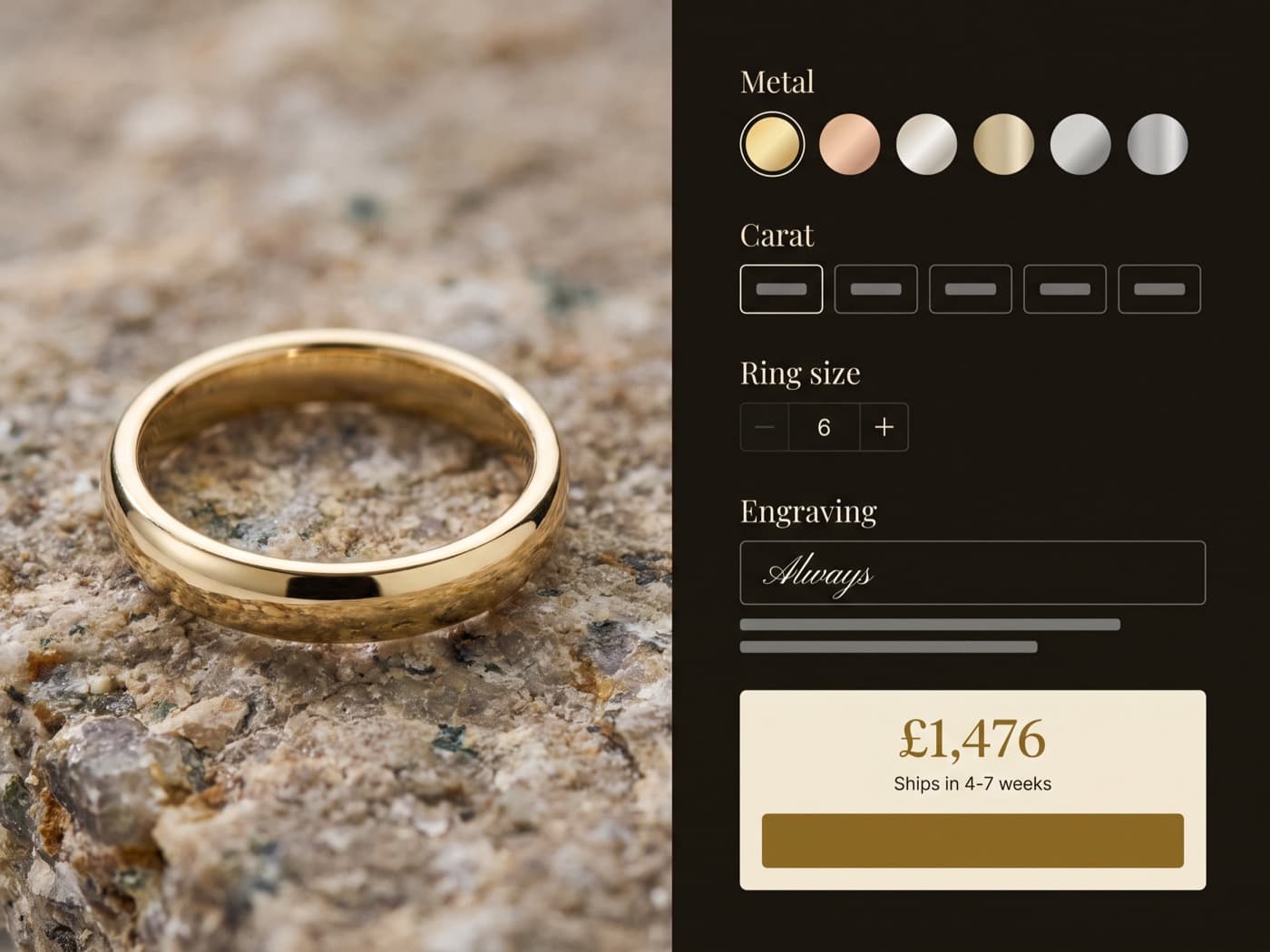
Metal, stone, carat, band width, ring size and engraving now live inline on the product page as a single stateful component. Every change re-prices, re-renders the correct photography and updates the lead-time estimate without a navigation. The whole variant matrix — 384 combinations across the core ring range — is resolved client-side from one payload.
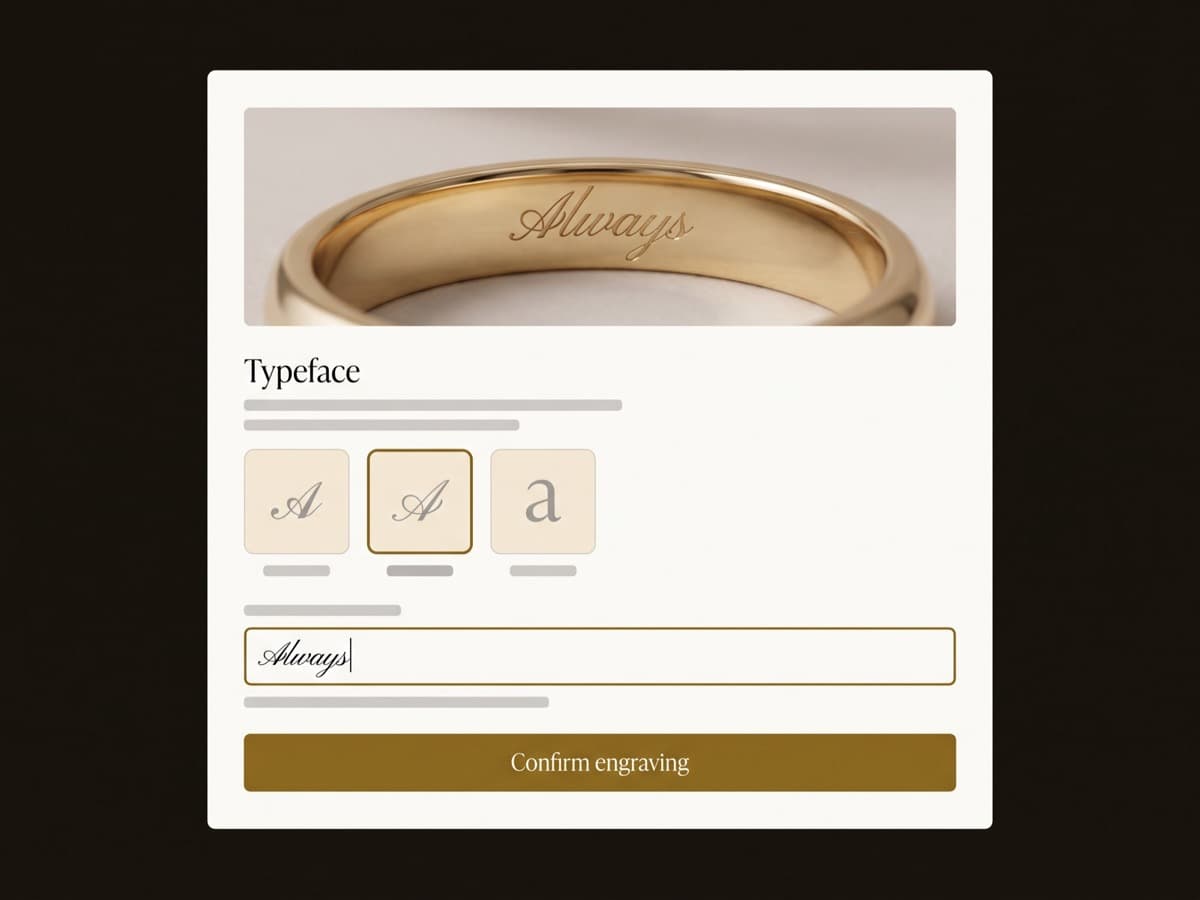
Engraving moved from a checkout note field, where it was invisible until too late, to a live preview in the buy box. It is the single most emotionally loaded input on the site and it had been an afterthought.
- 384 variant combinations resolved from one payload
- Live engraving preview in the chosen typeface
- Lead-time estimate recalculated per configuration
- 02
Make heavy photography fast without making it cheap
Hydrogen on Oxygen, AVIF with a WebP fallback, responsive art direction so the macro hallmark shot is never served to a 390px viewport, and a priority hint on exactly one image per page. Everything below the first two shots lazy-loads against an intersection margin tuned to how people actually scroll a gallery.
We held the quality ceiling deliberately high — the largest served image is still 340KB, not 90KB. Speed was never allowed to become an excuse for a stone that looks flat. Mobile LCP went from 5.8 seconds to 2.1 with the photography team signing off on every crop.
- Mobile LCP 5.8s → 2.1s, CLS under 0.02
- AVIF pipeline, 340KB ceiling on the hero shot
- Art-directed crops approved shot by shot
- 03
Treat the appointment as a conversion event
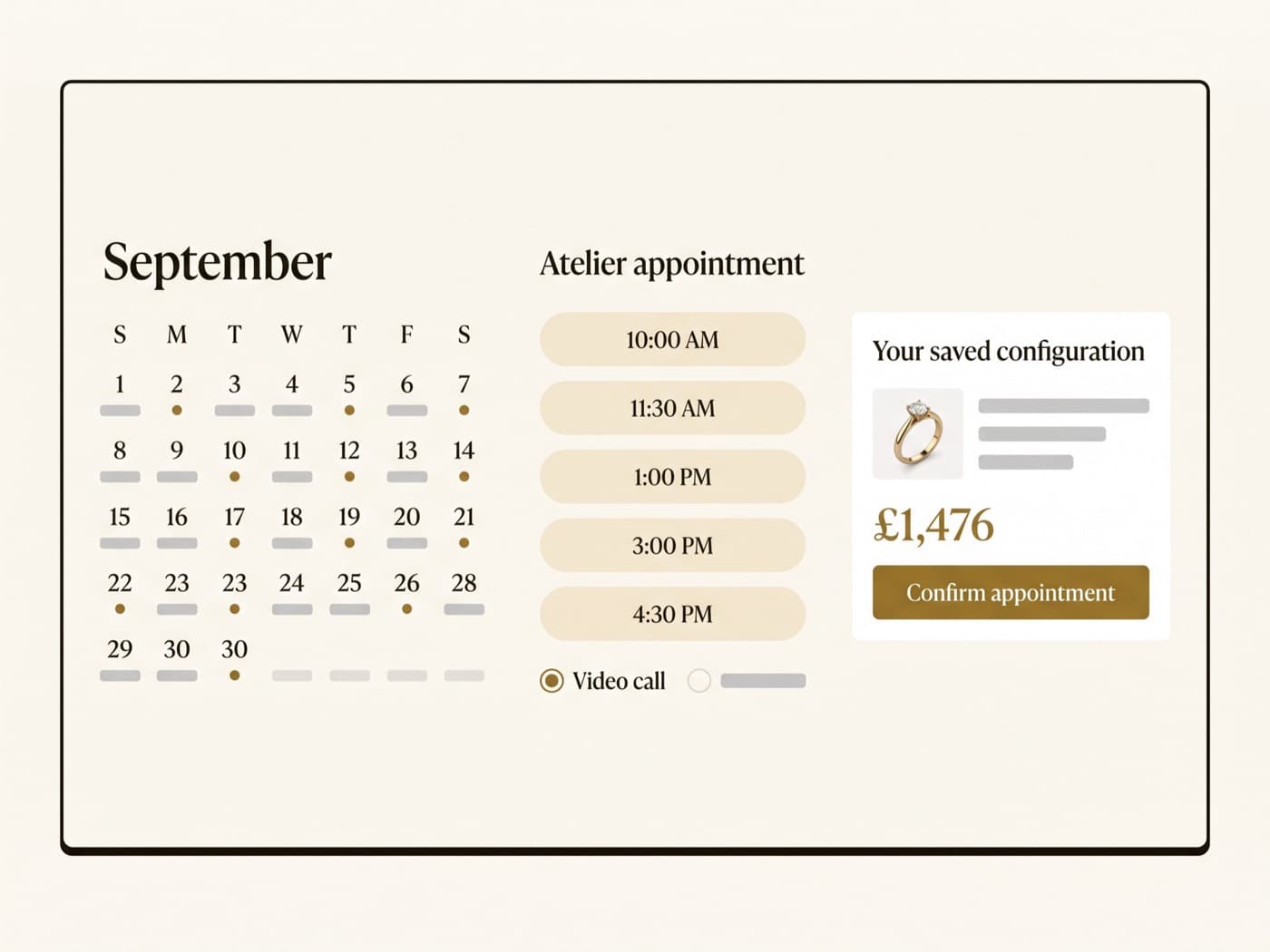
A meaningful share of high-value orders never start with an add-to-cart. They start with someone booking twenty minutes in the Edinburgh atelier or on a video call. That path had been a mailto link.
We built booking into the product page and the header, tracked it as a first-class conversion in GA4 with its own downstream revenue attribution, and gave the studio a pre-appointment brief so they walk in knowing which configuration the client has been circling for a week.
- Booking flow on PDP, header and post-enquiry email
- Appointments modelled as a conversion with revenue lookback
- Configuration history passed through to the studio brief
- 04
Test on a timescale this traffic can actually support
At 310 orders a month, a conventional A/B test on conversion rate would need most of a year to detect anything under a 20% swing. So we did not measure conversion rate. We measured revenue per session, which carries the order-value signal we were actually trying to move, and we ran sequential tests with pre-registered stopping boundaries so a long window does not become an invitation to peek.
Minimum test length was six weeks, several ran ten. Between and around them we leaned on things that do not need statistical power: eighteen moderated sessions with real buyers, on-site polls, and post-purchase interviews with anyone who spent over £2,000. Two of the four winners below started as a sentence someone said out loud in an interview.
Every test carried guardrails — return rate, appointment volume, refund rate and lead-time complaints. A lift in order value that quietly raises returns eight weeks later is not a lift.
- Revenue per session as the primary metric, not CVR
- Sequential testing, six-week floor, pre-registered boundaries
- 18 moderated sessions and 34 post-purchase interviews
The log
The build and test log
Eight months, four rebuild milestones and six tests. Uplift is the relative change in revenue per session for the tested audience; rebuild milestones are measured against the eight weeks before launch.
- 01
Headless PDP launch
Because configuration reloads the page and mobile LCP is 5.8s, rebuilding the product page in Hydrogen with an inline configurator will raise revenue per session across all traffic.
- 02
Engraving preview in the buy box
Because engraving is the stated reason for purchase in 4 of 10 interviews but is hidden until checkout, previewing it live during configuration will raise attach rate and order value.
- 03
Carat ladder with price-per-step
Because buyers ask "what does the next size up cost" in almost every appointment, showing the price delta between carat steps inline will raise average order value.
- 04
Hallmark and certification panel above the fold
Because authentication anxiety is the second-most-common exit-poll theme, moving assay and GIA certification above the fold will raise add-to-cart.
- 05
Finance calculator in the buy box
Because 0% finance is available to £5,000, surfacing monthly instalments beside the price will raise conversion on higher-carat configurations.
- 06
Book an appointment as PDP secondary action
Because high-value orders are preceded by a conversation, offering a booking slot beside add-to-cart will raise appointments without cannibalising direct purchases.
- Headless PDP launch+12.6%96%shipped
- Engraving preview in the buy box+7.9%97%shipped
- Carat ladder with price-per-step+6.2%95%shipped
- Hallmark and certification panel above the fold+0.6%flatnot shipped
- Finance calculator in the buy box-4.1%95%not shipped
- Book an appointment as PDP secondary action+5.4%96%shipped
| Experiment | Relative change | Confidence | Shipped |
|---|---|---|---|
| Headless PDP launch | +12.6% | 96% | Yes |
| Engraving preview in the buy box | +7.9% | 97% | Yes |
| Carat ladder with price-per-step | +6.2% | 95% | Yes |
| Hallmark and certification panel above the fold | +0.6% | flat | No |
| Finance calculator in the buy box | -4.1% | 95% | No |
| Book an appointment as PDP secondary action | +5.4% | 96% | Yes |
The results
What it moved
Average order value is up 19%, from £1,240 to £1,476, and revenue per session is up 34% — the gap between those two numbers is the speed work, which brought more of the same traffic far enough down the page to configure anything at all.
The finance calculator losing was the useful surprise. It read as reassuring in every internal review and it depressed revenue per session by 4.1% because it reframed a piece of jewellery as a monthly payment. We shipped it to the £5,000-plus range only, where nobody had been anchoring on instalments to begin with, and left it off everywhere else. The certification panel came back genuinely flat — trust was already doing its job lower on the page, and we stopped spending on it.
Appointments are the quiet result. Bookings went from 44 to 71 a month and the orders that follow one are worth roughly 2.3× an unassisted order. On this traffic volume that channel moves the annual number more reliably than any on-page test we could have run.
Eight months produced six tests. On a store with ten times the orders it would have produced forty. We would rather report six honest calls than forty read at day nine.
- Average order value+19%£1240£1476
- Revenue per session+34%£8.9£11.93
- Mobile LCP, PDP-64%lower is better5.8s2.1s
- PDP bounce, mobile-28%lower is better54%39%
| Metric | Before | After |
|---|---|---|
| Average order value | £1240 | £1476 |
| Revenue per session | £8.9 | £11.93 |
| Mobile LCP, PDP | 5.8s | 2.1s |
| PDP bounce, mobile | 54% | 39% |
| Period | Average order value |
|---|---|
| M1 | £1240 |
| M2 | £1238 |
| M3 | £1254 |
| M4 | £1271 |
| M5 | £1296 |
| M6 | £1318 |
| M7 | £1359 |
| M8 | £1397 |
| M9 | £1442 |
| M10 | £1476 |
“The audit alone found £180k of leaks a year. We signed the retainer before the meeting ended.”