Self-serve quoting that grew trade enquiries 2.4×
A note on these case studies
Every brand in these case studies is an illustrative composite, not a client. We built them so a whole engagement could be shown end to end: the brief, the constraints, the tests that lost and the shape of what a programme like this moves. What is real is the method, the failure modes and the way the work runs. The figures illustrate that method rather than reporting one named client’s audited results.
- Trade enquiries
- 2.4×
- from 38 to 92 a month
- Sales-qualified enquiries
- 2.9×
- from 21 to 61 a month
- Quote-to-order rate
- 31%
- from 22%
- Median time to first quote
- 3.1h
- from 31 hours
The brief
What they came to us with
Rothway Industrial distributes bearings, fasteners, drive components and sealing products to maintenance engineers, OEM buyers and facilities teams across the north of England. Around 1,900 trade accounts, an average order of £640, and a sales desk of five people who between them knew the catalogue better than any search box ever would.
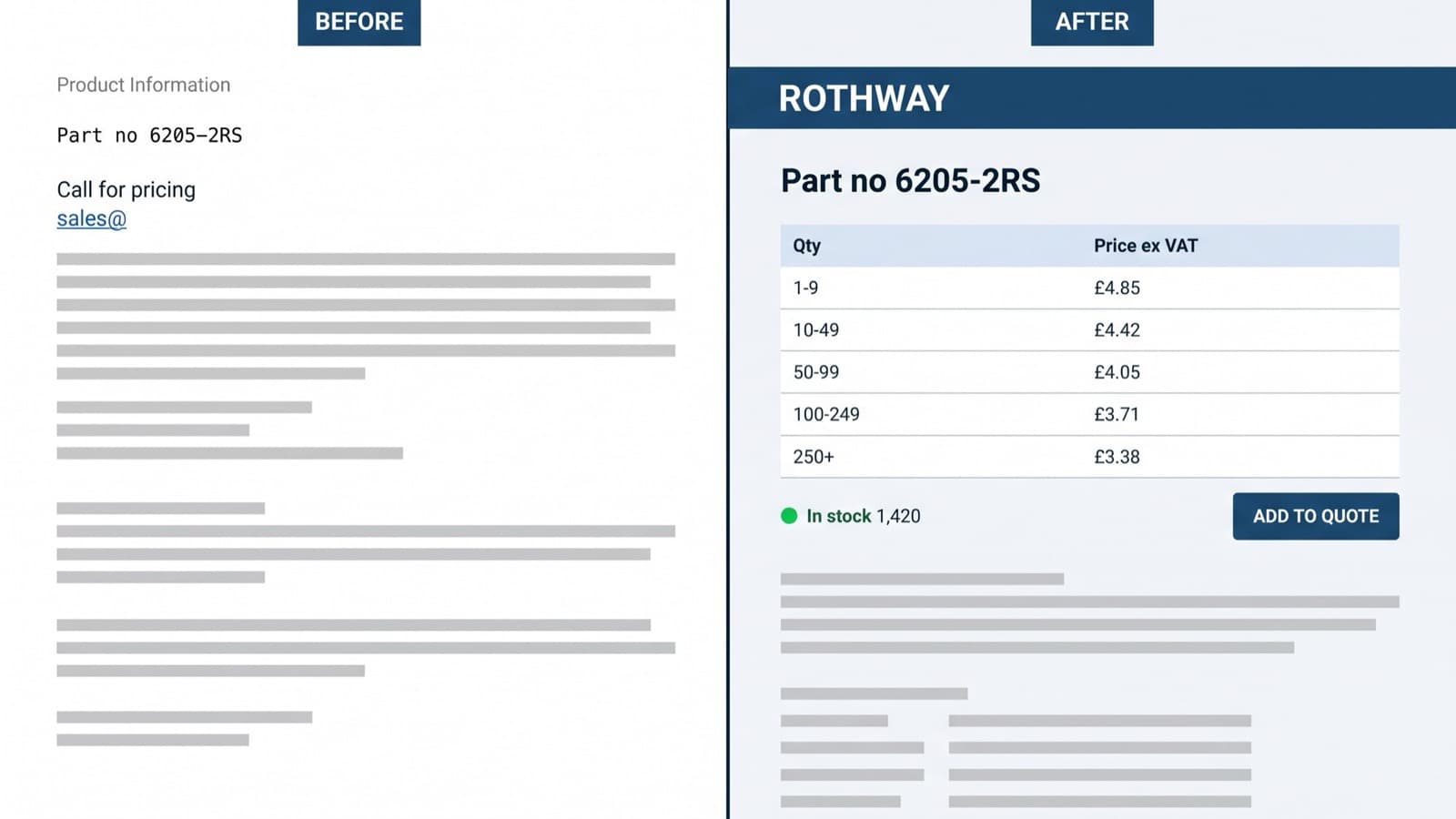
The website was a 2,000-page brochure. Every product ended in the same "call for pricing" sentence and a mailto link. Roughly 9,400 sessions a month produced 38 enquiries, most of them arriving as an email with a subject line of "Re: quote" and a body that said "the one we had last time".
The buyers were not browsing. They arrived with a part number in one hand and an internal purchase requisition in the other, needed a price and a lead time inside the working day, and left for a competitor who published both. The site was not underperforming because it was ugly. It was underperforming because it refused to answer the only two questions anyone asked it.
Constraints
- A 14-year-old ERP with no API. Stock and cost came out as a nightly CSV drop at 02:40, sometimes at 03:20, occasionally not at all.
- A sales team that believed self-serve pricing would cannibalise their relationships, and who owned the account data we needed.
- About 9,400 sessions a month. Too little traffic for a proper A/B programme, so decisions had to be evidenced before build rather than after.
- A board-level policy that trade pricing was confidential. Publishing list prices was permitted; publishing an account's negotiated tier was not.
The approach
How we worked the problem
The build was the easy half. Most of the seven months went on making a self-serve quoting flow that the sales desk actively wanted to use, and on defining an enquiry tightly enough that the headline number could not be gamed.
- 01
Sit on the sales desk before designing anything
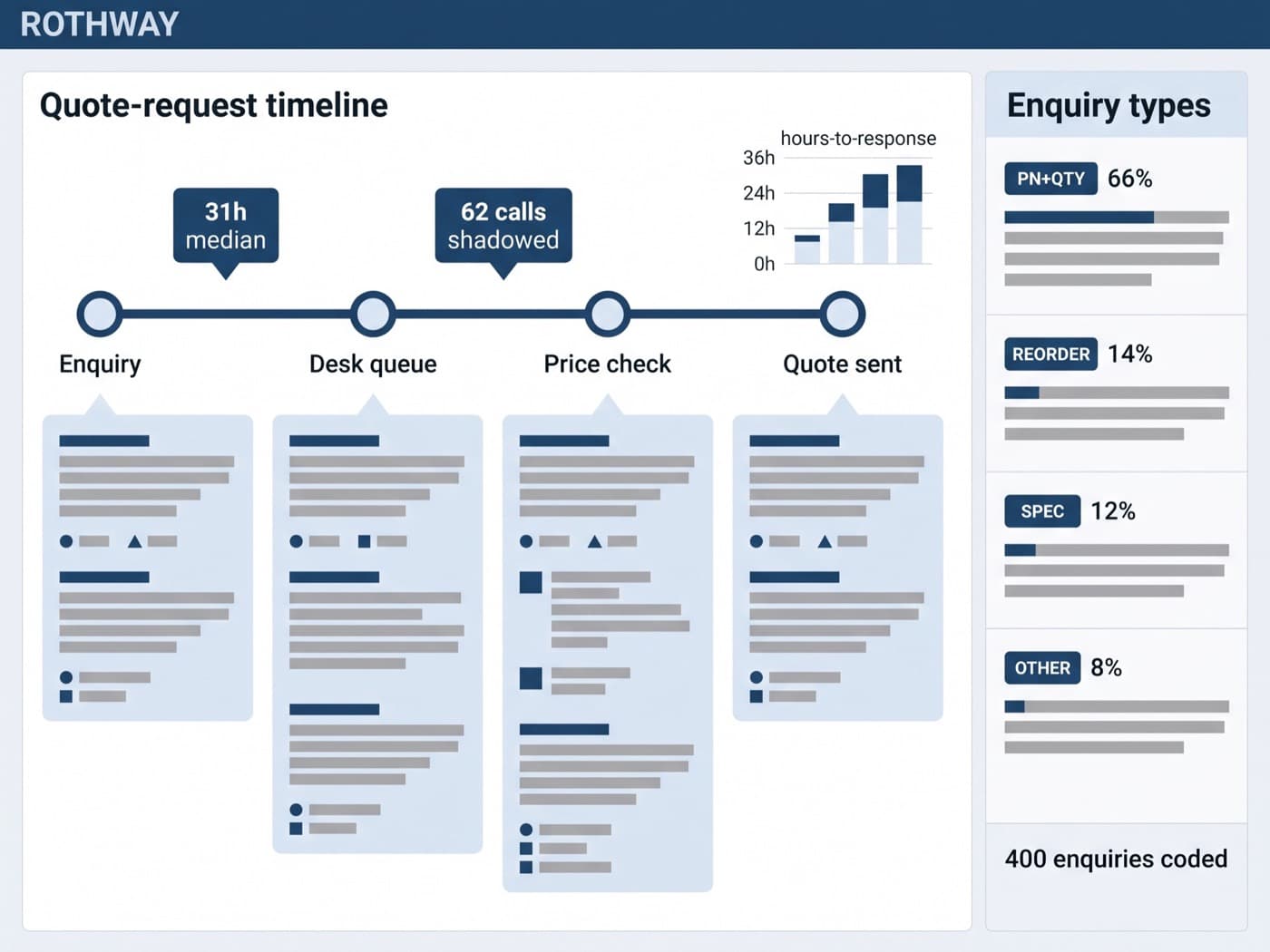
Three weeks of call shadowing, 62 recorded quote requests and a read of 400 historic email enquiries. Two thirds of inbound contained a manufacturer part number and a quantity, and nothing else. The desk was spending its day retyping numbers that the customer already knew, and the median time from enquiry to a price landing in an inbox was 31 hours because quotes queued behind whoever was on the phone.
That reframed the brief. Self-serve was not there to remove the salesperson; it was there to stop them being a fax machine.
- 62 quote calls shadowed and timed end to end
- 400 historic email enquiries coded by intent
- Time-to-quote measured per rep, not as a site average
- 02
Publish prices, but only the ones policy allows
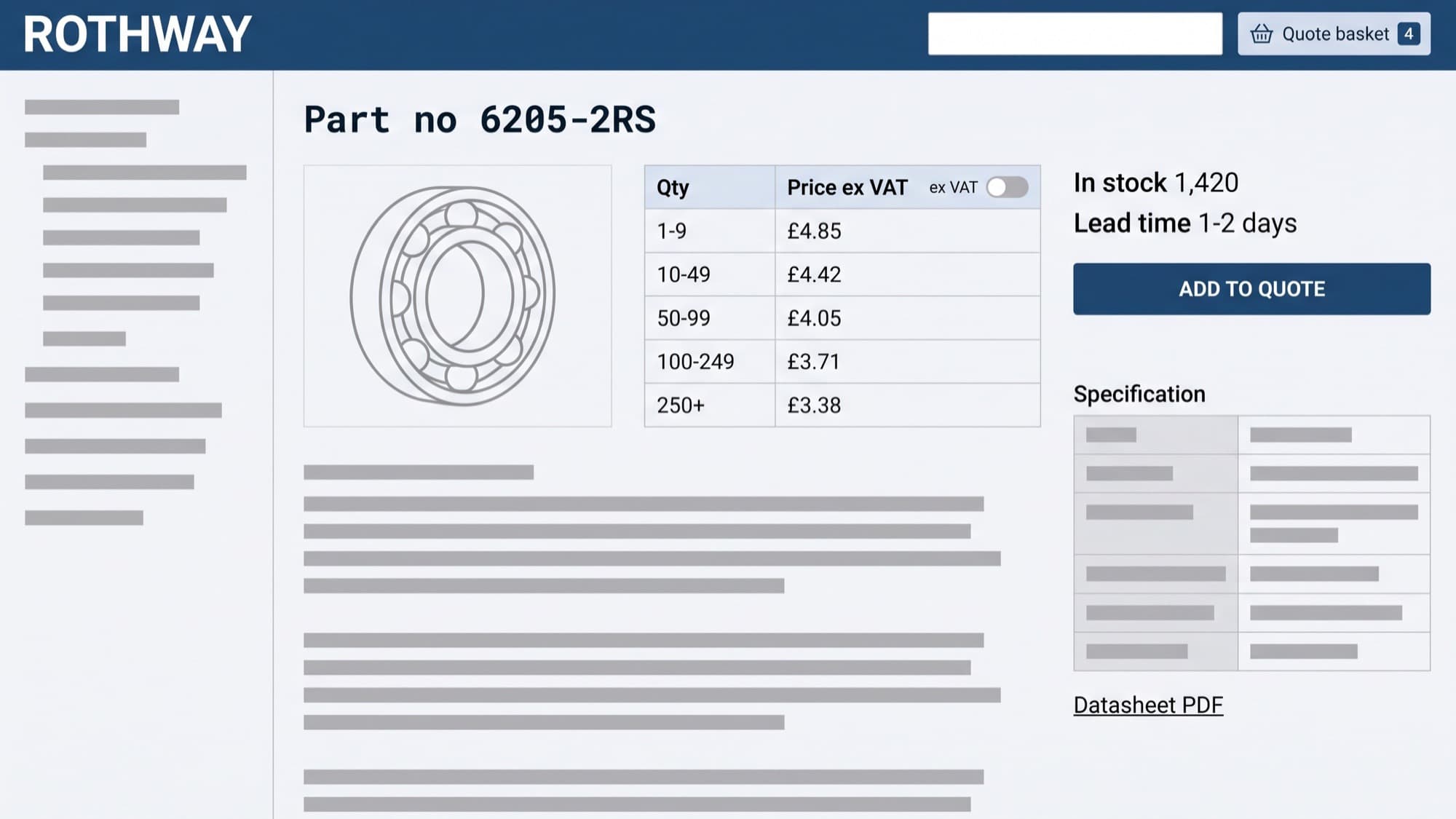
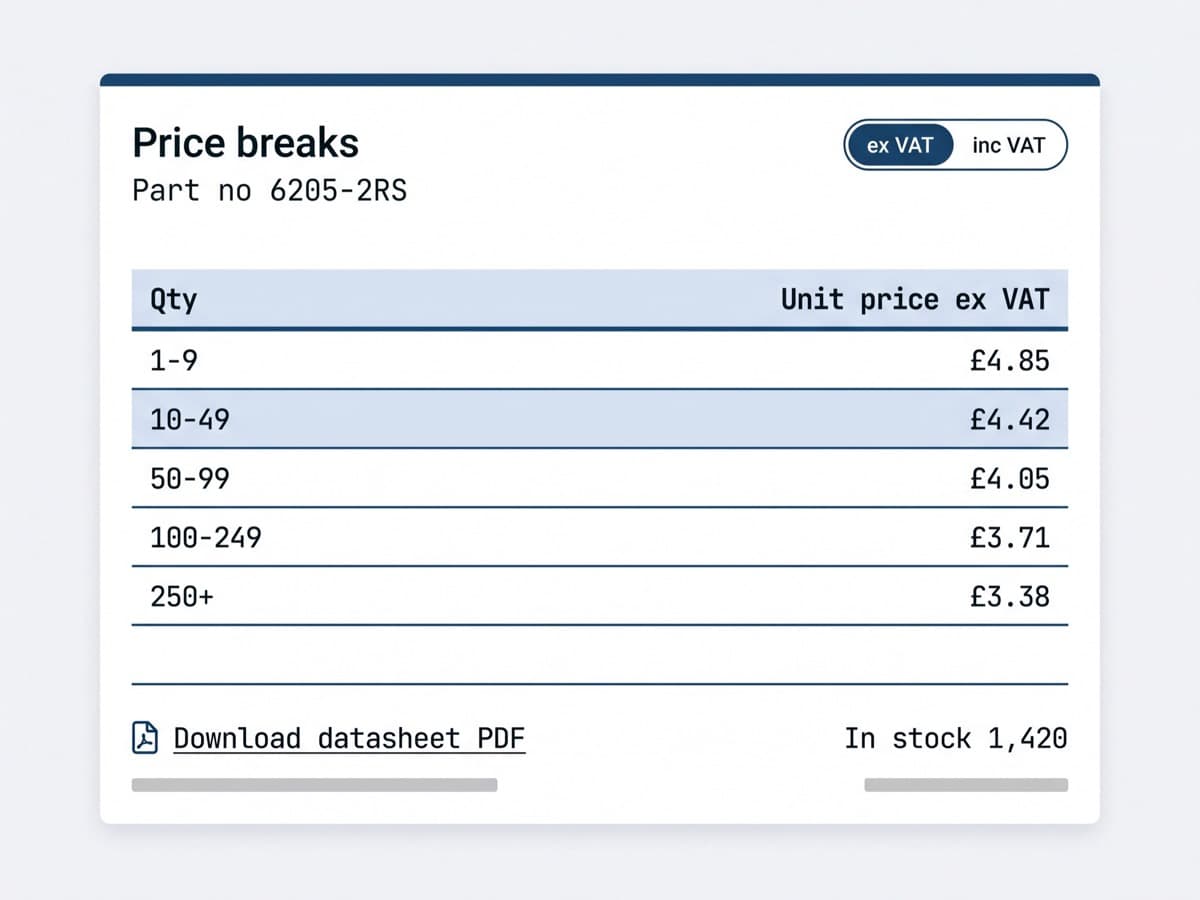
We separated three things the business had been treating as one: list price, published quantity breaks, and account-negotiated tiers. List and breaks went public on every product, in five bands, VAT-exclusive by default with a toggle, because a maintenance buyer reconciling against a requisition wants the ex-VAT figure and a sole trader does not.
Negotiated tiers stayed behind login. A signed-in account sees its own tier applied inline with the list price struck through. That was the single change the sales desk ended up defending hardest in the board review.
- Five quantity bands per SKU, generated from ERP cost bands
- VAT-exclusive default with a persistent per-account toggle
- Negotiated tiers rendered only for authenticated accounts
- 03
Build the quote basket, not a checkout
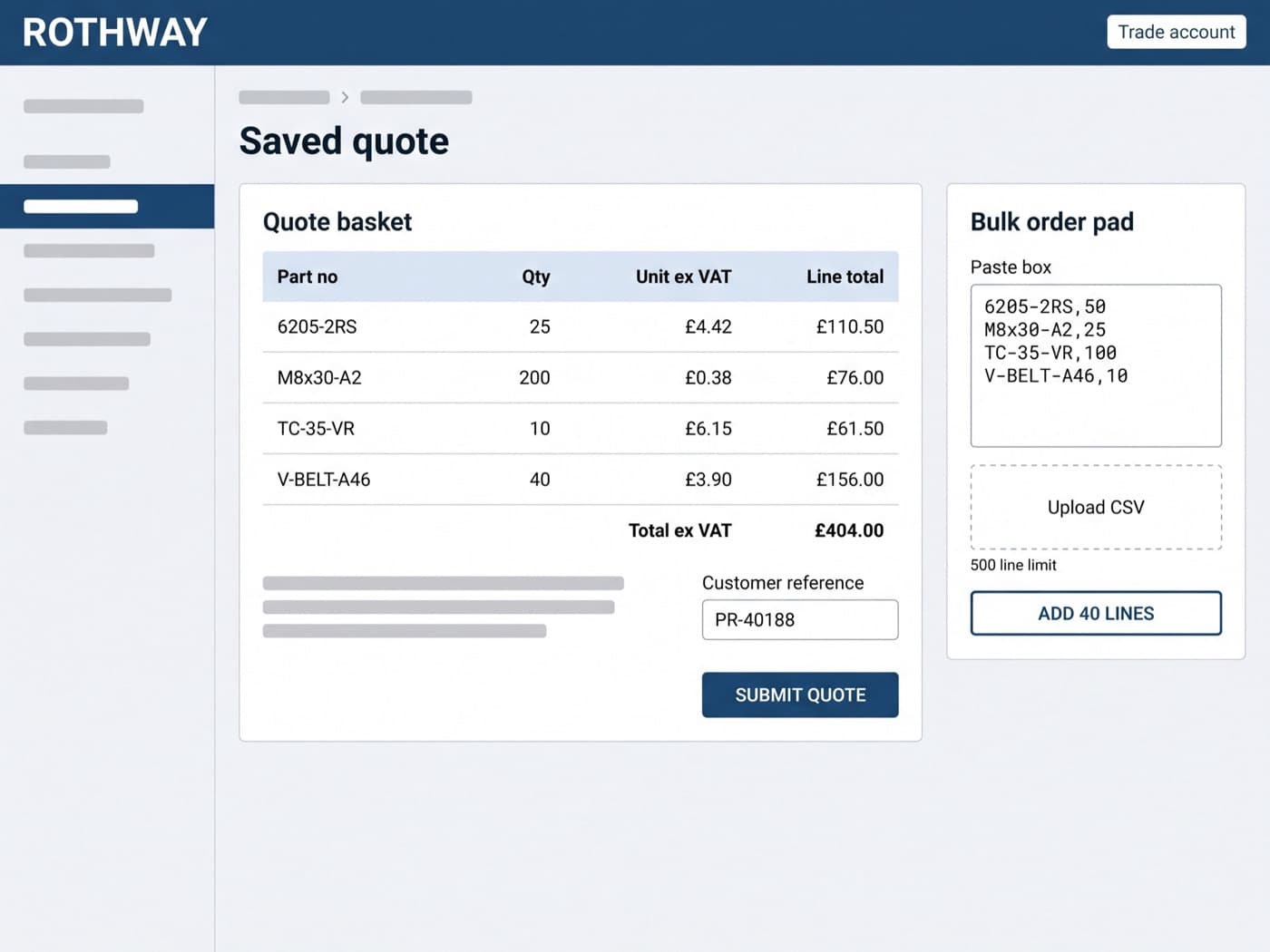
WooCommerce does carts well and quotes not at all, so the basket was rebuilt as a quote document: multiple lines, per-line quantities and notes, a customer reference field, and a bulk order pad that accepts a pasted or uploaded CSV of part numbers and quantities. A 40-line requisition became one paste.
Submission writes a structured quote into WordPress, emails the desk with every line pre-filled, and routes to a named rep by postcode and account. Nothing about a submitted quote is retyped by a human. Credit-account holders can convert their own quote to an order once a rep approves the price.
- CSV and paste order pad, 500-line ceiling
- Quote routing by postcode and existing account owner
- Saved quotes, re-quote from history, 90-day expiry
- 04
Make datasheets the front door, and make the metric honest
Every product got its specification table, tolerance data and a downloadable PDF datasheet rendered as indexable HTML rather than a locked file. Gating those behind a form was tested and rejected (see the log). Organic entries to product pages grew 78% over the engagement, almost all of it long-tail part-number and dimension queries.
Enquiry volume is the easiest B2B metric in the world to inflate: put a quote button on every page and the count goes up while nothing else does. So we fixed the definition before launch. A counted enquiry has at least one line item with a real SKU, a valid company name and either a work email domain or an existing account, deduplicated per domain within 14 days, and excluding reorders from live accounts. Everything else is logged separately. On top of that we report sales-accepted enquiries and quote-to-order rate. If volume ever rises while those two fall, the number is noise and we say so.
- Specification tables and datasheets as indexable HTML
- Enquiry counted only with a valid SKU line and company domain
- 14-day domain deduplication, reorders reported separately
The log
Build and test log
Seven months of releases. Low traffic meant most decisions were evidenced before build and validated after; where volume allowed we split traffic. Change is measured against qualified enquiries per session for the pages affected.
- 01
Published quantity price breaks
Because two thirds of inbound enquiries already carry a part number and quantity, showing five published price bands on the product page will raise qualified enquiries rather than remove the reason to make contact.
- 02
Quote basket replacing the mailto link
Because free-text emails cost the desk 31 hours of round trips, a structured multi-line quote basket will raise submitted enquiries and cut time to first quote.
- 03
Gated datasheet downloads
Because datasheets are the most-requested asset, requiring an email to download them will capture leads earlier in the cycle.
- 04
VAT-exclusive display with toggle
Because trade buyers reconcile ex-VAT, defaulting to VAT-exclusive prices will raise add-to-quote rate.
- 05
CSV bulk order pad
Because maintenance requisitions arrive as spreadsheets, a paste-and-upload order pad will raise lines per quote and repeat quoting from existing accounts.
- 06
Live stock indicator from the nightly feed
Because lead time is asked for in almost every call, showing a banded in-stock indicator with a stated freshness time will raise quote submissions.
- 07
Rep claim-and-respond routing
Because unowned enquiries sat unanswered overnight, routing each quote to a named rep with a two-hour claim window will cut time to first quote without adding headcount.
- Published quantity price breaks+18.7%96%shipped
- Quote basket replacing the mailto link+26.4%98%shipped
- Gated datasheet downloads-12.3%97%not shipped
- VAT-exclusive display with toggle+0.8%flatshipped
- CSV bulk order pad+9.2%95%shipped
- Live stock indicator from the nightly feed+7.5%94%shipped
- Rep claim-and-respond routing+5.9%95%shipped
| Experiment | Relative change | Confidence | Shipped |
|---|---|---|---|
| Published quantity price breaks | +18.7% | 96% | Yes |
| Quote basket replacing the mailto link | +26.4% | 98% | Yes |
| Gated datasheet downloads | -12.3% | 97% | No |
| VAT-exclusive display with toggle | +0.8% | flat | Yes |
| CSV bulk order pad | +9.2% | 95% | Yes |
| Live stock indicator from the nightly feed | +7.5% | 94% | Yes |
| Rep claim-and-respond routing | +5.9% | 95% | Yes |
The results
What it moved
Trade enquiries went from 38 a month to 92, a 2.4× lift, on traffic that grew only 21%. The more useful number sits underneath it: sales-accepted enquiries went from 21 to 61, so the qualified share rose from 55% to 66% while the volume grew. Quote-to-order moved from 22% to 31%. If self-serve pricing were pulling in tyre-kickers, both of those would have fallen.
Median time to first quote fell from 31 hours to 3.1, and about a fifth of quotes from credit-account holders now convert to an order without a rep touching the price at all. Inbound "what does this cost" calls dropped by roughly half, which is the change the desk actually feels.
The sales team's objection turned out to be half right. Published prices did lose Rothway a handful of low-margin commodity enquiries to cheaper distributors, and those were genuinely lost, not recovered elsewhere. It also stopped five people spending their mornings quoting £40 seal kits. Average quote value rose from £610 to £790 because the desk had time to work the larger ones.
The retainer now covers catalogue expansion and the datasheet content programme. The team publish new product families themselves in ACF, which was the other half of the brief.
- Trade enquiries per month+142%3892
- Sales-qualified per month+190%2161
- Quote-to-order rate+41%22%31%
- Median time to first quote-90%lower is betterh31h3.1
| Metric | Before | After |
|---|---|---|
| Trade enquiries per month | 38 | 92 |
| Sales-qualified per month | 21 | 61 |
| Quote-to-order rate | 22% | 31% |
| Median time to first quote | h31 | h3.1 |
| Period | Trade enquiries |
|---|---|
| M1 | ×1 |
| M2 | ×1.05 |
| M3 | ×1.24 |
| M4 | ×1.41 |
| M5 | ×1.58 |
| M6 | ×1.72 |
| M7 | ×1.69 |
| M8 | ×1.91 |
| M9 | ×2.08 |
| M10 | ×2.22 |
| M11 | ×2.4 |
“Our team publishes new ranges and datasheets twice a week without touching a developer. That was the whole brief, and they nailed it.”