Let’s start with the uncomfortable part: a badge on a website has never increased anyone’s revenue per visitor.
We spend our working lives proving that claims need evidence. We run tests precisely because opinions, including confident, well-paid, senior opinions, are wrong often enough to be expensive. So it would be strange for us to publish a post asking you to be impressed by a listing on a directory.
We’re publishing it anyway, because the listing is real, because it says something specific about the category we’ve been placed in, and because we think the criteria behind it are worth pulling apart.
What happened
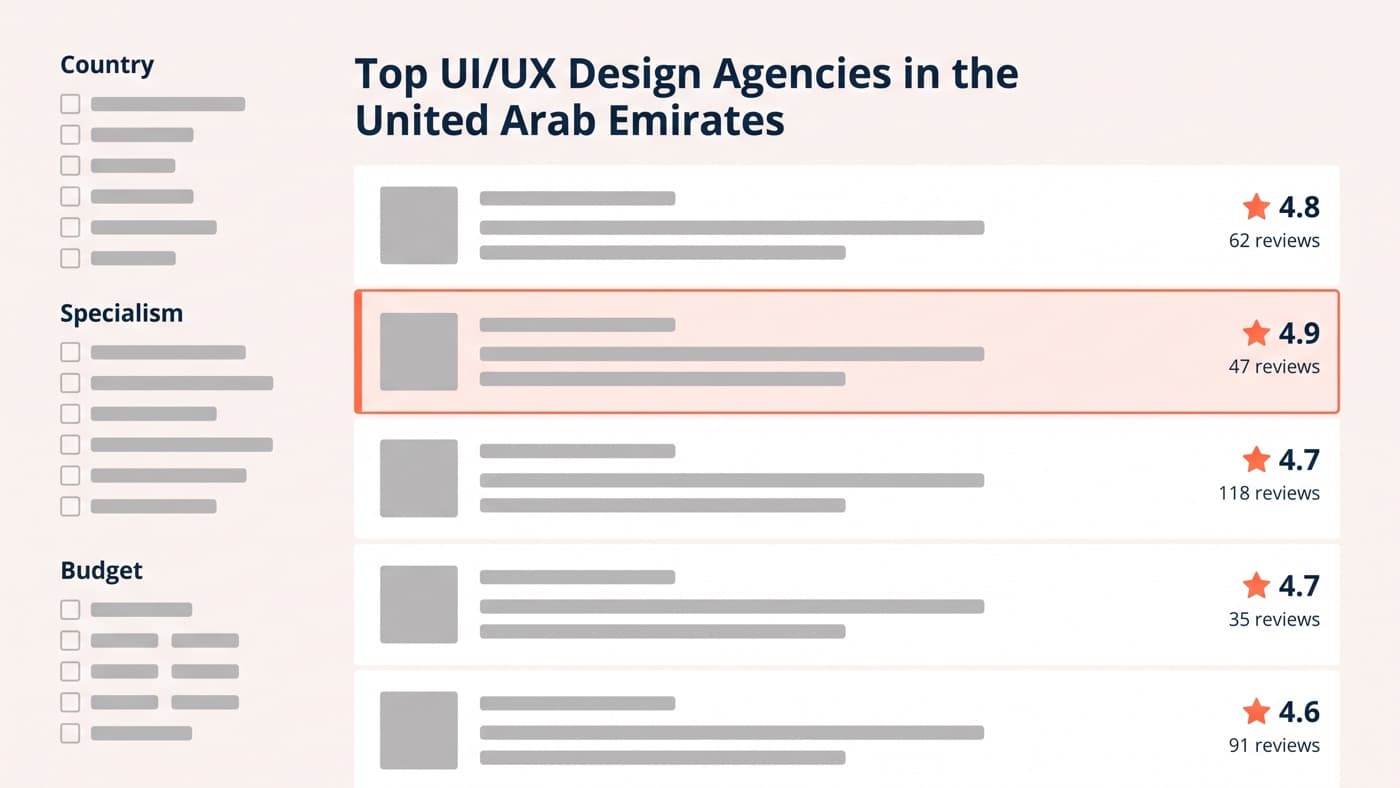
Optyv has been named among the Top UI/UX Design Agencies in the United Arab Emirates by DesignRush, the agency directory and brand discovery platform. You can see the listing here: As seen on DesignRush.
DesignRush maintains ranked directories of agencies across design, development, marketing, and adjacent disciplines, broken out by country and specialism. Buyers use it the way they use any shortlist: to reduce a market of thousands down to a handful worth a first call. The UAE UI/UX category we’ve been listed in sits alongside agencies like ELEKS, Musemind, Lollypop Design Studio and Tenet, companies we’ve competed with, borrowed ideas from, and occasionally lost to.
What a directory listing is, honestly
Directories are a filtering mechanism, not a verdict. A listing tells you an agency exists, operates in a market, has enough client history to be reviewable, and cared enough to maintain a profile. That’s a genuinely useful floor. It is not the same as evidence that the agency will make you money, and it says nothing at all about which of the twenty agencies that clear the same floor is the right one for your storefront.
We’d rather say that plainly than pretend otherwise. If you’re evaluating agencies (us included), a directory should be where the process starts, not where it ends.
What we do think is meaningful is the category. Being placed in UI/UX rather than, say, general web design is the part that matches how we actually work.
Why UI/UX, for a conversion studio
Optyv is a conversion studio. Everything we do (A/B testing, Shopify development, WordPress development, UI/UX design) feeds one number: revenue per visitor. We don’t run a design practice and a testing practice as separate businesses that occasionally talk.
That’s not a positioning flourish. It’s a response to a failure mode we see constantly in ecommerce.
The failure mode goes like this. A brand hires a design agency. The agency produces something beautiful, defensible, and completely untested. It ships as a full redesign. Conversion rate drops eleven percent and nobody can say which of the four hundred changes caused it, because they all launched on the same Tuesday. Six months later the brand hires a CRO agency to fix it, and that agency spends its first quarter undoing design decisions that were never validated in the first place.
Design and conversion aren’t sequential disciplines. Treating them as sequential is how brands end up paying twice: once for the redesign, and again for the quarter somebody spends working out which part of it to reverse.
So when we do UI/UX work, the deliverable isn’t a beautiful file. It’s a hypothesis with a measurement attached. A checkout redesign isn’t finished when it looks right; it’s finished when it’s beaten the control on revenue per visitor with enough traffic behind it to believe the result. Sometimes our own designs lose. We ship the control and say so.
That’s the discipline the UI/UX listing points at, even if a directory can’t measure it directly.
If you would rather have the mechanics than the argument, the way we run design and testing as one loop is written up on the service page.

The numbers we’d rather be judged on
If you’re weighing us against another agency, here’s what we’d suggest you ask, of us and of them. These questions are harder to game than any badge:
- Test velocity. How many experiments does the team ship per month, per client? Volume isn’t quality, but below a certain rate you simply can’t learn fast enough to matter.
- Win rate, stated honestly. Any agency claiming most of its tests win is either measuring badly or only running tests it already knows the answer to. Industry-typical win rates sit far lower than people admit publicly. Ask for the losers.
- How results are validated. Ask whether they run holdout groups, how they handle sample ratio mismatch, what they do about novelty effects, and how long tests run. Ask what happens when a result is inconclusive; the answer reveals more than any case study.
- Revenue impact, not conversion rate. Conversion rate can rise while revenue falls. It happens whenever a change pushes people toward cheaper products or smaller baskets. If an agency reports conversion lift without revenue per visitor, ask why.
- Client durability. How long do clients stay? Compounding gains take quarters, not weeks. Short average tenure usually means someone stopped seeing returns.
The third of those is the one that separates a testing practice from a design practice that owns a testing tool, which is why how a result gets validated is the part of our own process we document in the most detail.
For our part: Optyv holds a 4.9 average across 47 client reviews, and we work with DTC and mid-market ecommerce brands across Europe and the United States. [FILL: add 1-2 concrete proof points here, e.g. in the last 12 months we shipped X tests across Y accounts, with a Z% win rate and a median revenue-per-visitor lift of N% on winning variants. Use real figures only.]
What’s next
The listing runs in the UAE UI/UX category, and we’ll keep the profile current with new work as it clears the confidentiality bar to publish. That bar is also why any agency’s public case studies lag a year or more behind what it is actually doing this quarter, ours included.
More usefully: the work doesn’t change. We’ll keep running experiments, keep publishing the ones that failed alongside the ones that worked, and keep arguing that the only defensible reason to make a design decision is that you measured it.
If you’re an ecommerce brand sitting on traffic that isn’t converting the way it should, that’s the conversation we’re interested in. Tell us what the numbers look like and we’ll tell you what we would test first.
Optyv is a conversion studio for ambitious ecommerce brands, specialising in A/B testing, Shopify and WordPress development, and UI/UX design. Every service feeds one number: revenue per visitor.