Shopify now sells to trade natively: company profiles with locations and contacts, catalogues carrying negotiated prices, volume pricing, quantity rules and net payment terms, and since April 2026 most of that sits on Basic upwards rather than on Plus alone. WooCommerce ships none of it in core and buys all of it with plugins. The verdict turns on one question, which is whether any single account needs its own price.
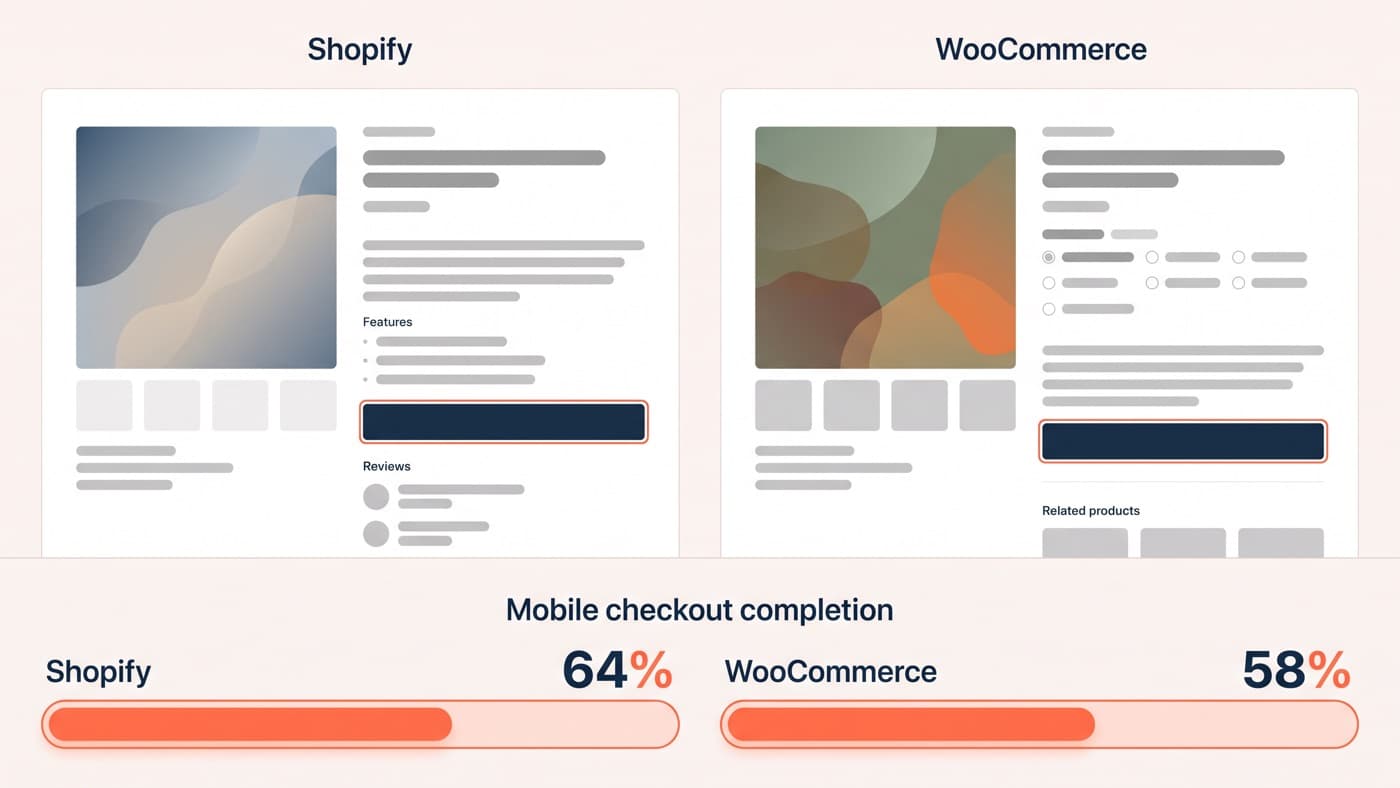
This is deliberately not the conversion argument. The two platforms compared on conversion is a different post reaching a different answer, because checkout completion and page speed are not what decides a trade build. This one compares capability: what each platform can express about a company, a price and a payment, and what it makes you buy or write to express it.
What Shopify B2B does natively
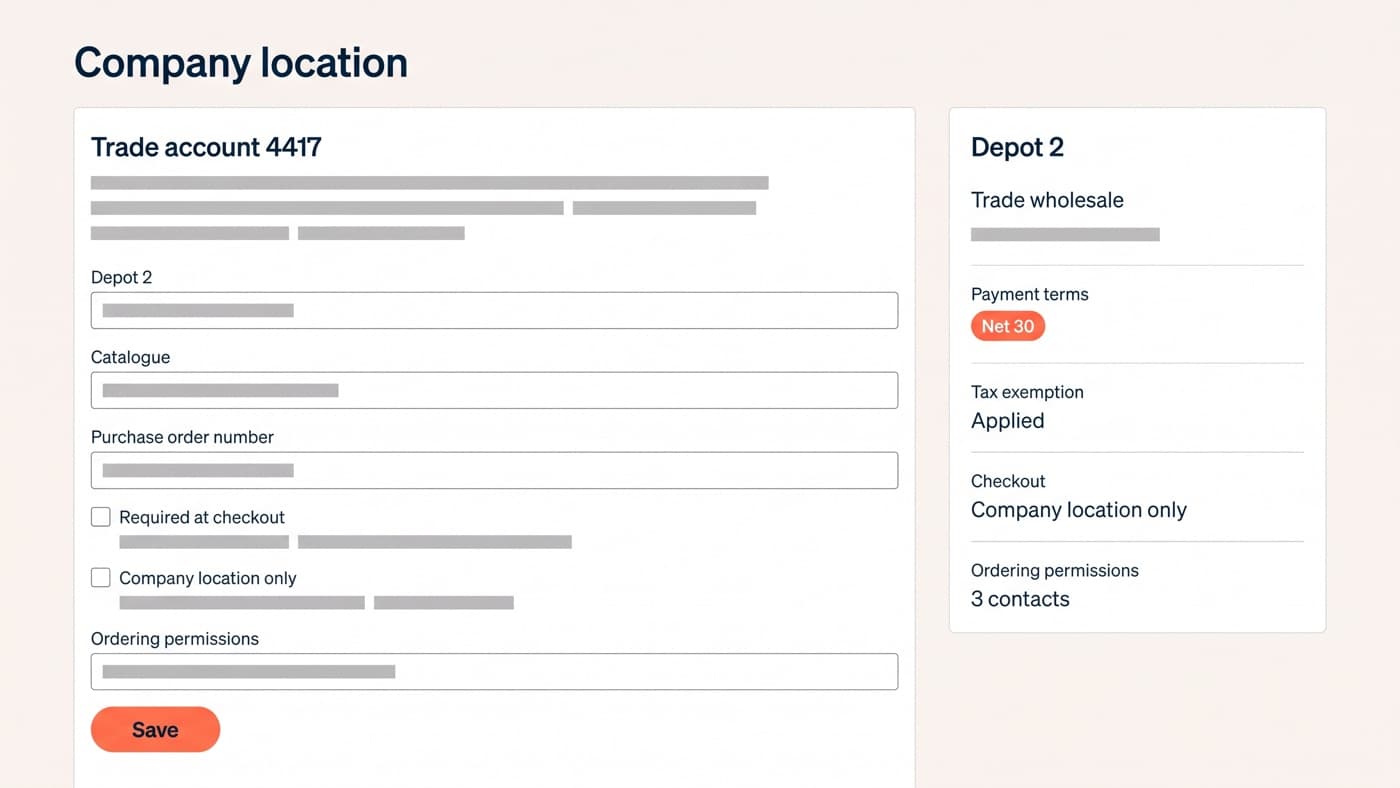
The unit of the model is a company rather than a customer. A company holds locations, and a location holds the things a trade account actually varies by: the catalogue it buys from, the payment terms it buys on, its tax exemption status, its shipping addresses and which of its contacts may place an order at all. That is the piece WooCommerce has no answer for out of the box, and it is worth being precise that it is a data model rather than a feature.
On top of it sit quantity rules and volume pricing, quick order lists, reorders from past orders, draft orders carrying a purchase order number, sales staff permissions and Shopify Flow automations that can read B2B objects. Payment terms cover net 7, 15, 30, 45, 60 and 90 as well as due on fulfilment, with a fixed date available on draft orders, and they are set per company location rather than per order, which is documented at help.shopify.com/en/manual/b2b/checkout-and-orders/payment-terms.
The plan rule is where the honest answer lives, and it changed in April 2026. Basic, Grow and Advanced now carry companies and locations, volume pricing, quantity rules, net terms and up to three active catalogues assigned across B2B markets. Plus keeps three things: an unlimited catalogue count, the ability to assign a catalogue directly to a named company or location for customer-level pricing, and deposits with partial payments. The matrix is published at help.shopify.com/en/manual/b2b/getting-started/plan-features, and the middle item on that list is the one that decides most builds.
Three catalogues is not a small allowance, and it is not a large one either. It is enough for a tiered trade book, gold and silver and bronze, or for three regional price lists, and it stops dead at the store whose sales team has agreed forty separate rates. That is a cliff rather than a slope: you are either inside the catalogue model or you are buying a plan tier to escape it, and there is no halfway position where a plugin quietly fills the gap.
What WooCommerce needs a plugin or custom work for
All of it. WooCommerce core has no company, no trade price, no approval workflow and no payment term, and its tax display is two store-wide settings rather than something a customer type can vary. Every capability in the section above arrives as an extension or as code somebody on your side writes and maintains.
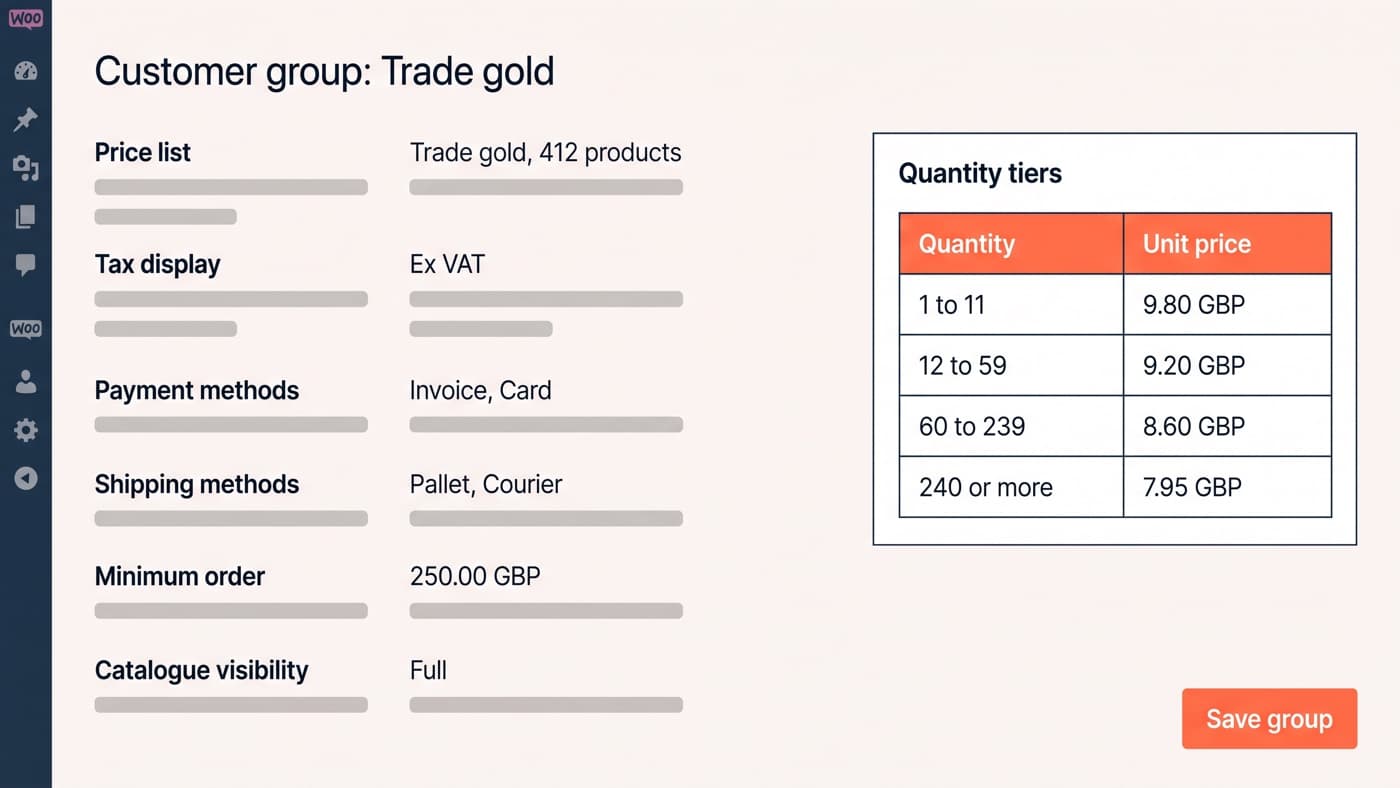
The free end of that market is narrower than its marketing suggests. Wholesale Suite’s free core adds one new user role, wholesale prices set per product and per variation, a switch to hide the retail price from wholesale customers and a private store mode that hides price and add to cart until login, and its own listing at wordpress.org/plugins/woocommerce-wholesale-prices puts quantity based pricing, tax controls, gateway restrictions, minimum order amounts and more than one wholesale tier in the premium products. Which family of extension to pick is a comparison in its own right, and the build around it is covered in our WooCommerce trade accounts guide.
Shopify B2B and WooCommerce compared, capability by capability
| Capability | Shopify B2B | WooCommerce |
|---|---|---|
| Trade customer model | A company with locations, contacts and per-contact ordering permissions, separate from the customer record | A WordPress user role, or a group entity a plugin layers over roles |
| Negotiated catalogues | Up to 3 active catalogues assigned through B2B markets on Basic, Grow and Advanced; unlimited on Plus | Unlimited price rules, because there is no native concept to cap |
| Per-account contract pricing | Plus only: catalogues assigned directly to one company or location | Any plan, any host, from a plugin or from code |
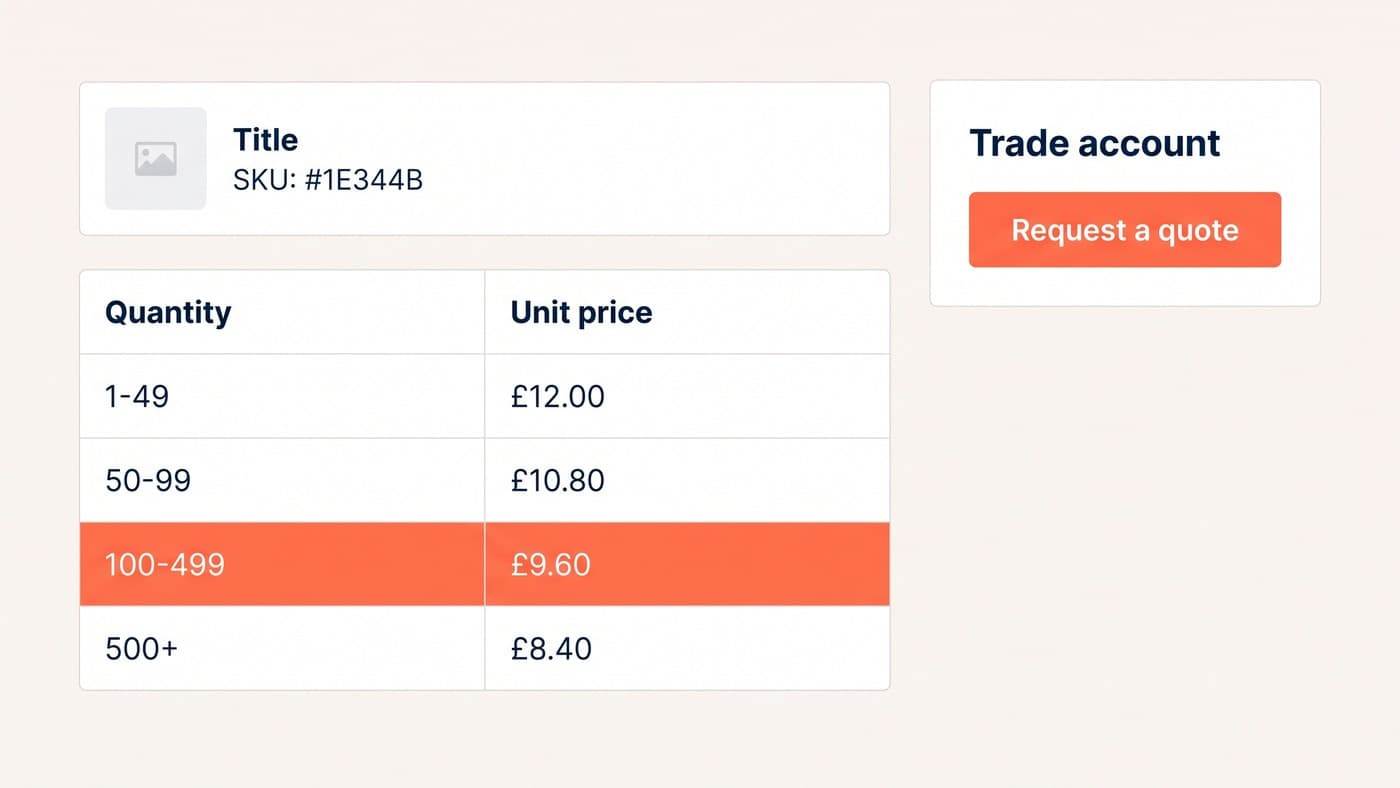
| Volume and quantity rules | Native on every plan that supports B2B | The premium tier of a wholesale plugin, or code |
| Payment terms | Net 7 to net 90, due on fulfilment, or a fixed date on draft orders, set per company location | An invoice gateway that completes an order unpaid, bought or written |
| Purchase order numbers | Supported, including on draft orders | A checkout field you register, then validate and print yourself |
| Tax exemption | Configured per company alongside catalogues and terms | Per-role handling from a plugin; core has two store-wide tax display settings |
| Where the rules live | On the company record in Shopify’s admin, upgraded by Shopify | In a plugin’s tables, a rule engine or your own code, upgraded by you |
Where Shopify genuinely wins for trade
The account lifecycle is the strongest case and it is not close. Registering a company, approving it, attaching contacts with different permissions, giving it a catalogue and terms, then letting a named buyer reorder against a purchase order is one product rather than five plugins, and nobody has to own the seams between them. On WooCommerce that same flow is assembled, and assembled things drift.
The second is that the trade experience runs on the same checkout as everything else, so it inherits the wallets, the address validation and the fraud handling without a second integration. The third is quieter and shows up in year two: the rules live on a record Shopify upgrades, not in a plugin whose author may stop shipping. A trade store is a system somebody has to keep running for a decade, and that is a longer commitment than most feature comparisons price in.

Where WooCommerce genuinely wins for trade
Contract pricing below Plus, which is a bigger category than it sounds. Distributors, industrial suppliers and anyone whose sales team negotiates annually do not have three price tiers, they have as many prices as they have accounts. Shopify answers that on Plus and not below it. WooCommerce answers it on any hosting plan you like, because a price rule is a row in a table nobody capped.
The second win is pricing that comes from somewhere else. When the authoritative price lives in an ERP and the website is a display layer, WooCommerce is a better display layer, because you can write the lookup rather than mapping your ERP onto a catalogue model designed by somebody who has not seen your contracts. The third is the ordinary WordPress one: if the funnel starts with specification sheets, application guides and search traffic, the publishing side is already there.
All three come with the same invoice attached. Somebody owns the plugin stack, the update path and the performance cost of computing a logged-in price on every request, and that person has to be real. Trade stores where WooCommerce wins are, without exception, the ones where that job has a name against it.
How to choose between them
Answer these five in order, and stop at the first one that decides it:
- Does any single account need a price no other account sees? Yes and you are not going to Plus, and the answer is WooCommerce.
- Can your whole trade book fit into three catalogues, or five, or ten tiers? Three or fewer works on any Shopify plan; more of them is a Plus conversation.
- Where does the authoritative price live? If the answer is an ERP, pick the platform whose integration you can actually staff, because neither one is going to own that data.
- Does the same store also sell to consumers? A blended store on Shopify is one admin and one checkout; the same thing on WooCommerce is a set of conditional rules somebody wrote.
- Who maintains it in year three? A named person, or a retainer with a name in it, or Shopify. If none of those, choose the platform that does its own upgrades.
What should not decide it is the feature grid, because both platforms now tick every row on it. The difference is where the rules live and who is responsible for them, and that is a staffing question wearing a technology costume. If you are weighing a Shopify build against a WooCommerce one for a trade catalogue and the honest answer is not obvious yet, bring us the pricing rules rather than the requirements document. The rules decide it faster.