Month-3 subscription retention from 41% to 58%
A note on these case studies
Every brand in these case studies is an illustrative composite, not a client. We built them so a whole engagement could be shown end to end: the brief, the constraints, the tests that lost and the shape of what a programme like this moves. What is real is the method, the failure modes and the way the work runs. The figures illustrate that method rather than reporting one named client’s audited results.
- Month-3 retention
- 58%
- from 41%
- 12-month subscriber LTV
- +45%
- from £121 to £175
- Cancel starts ending in a skip or pause
- 34%
- from 9%
- Experiments shipped
- 9
- 5 winners, 2 flat, 2 losses
The brief
What they came to us with
Lumen Apothecary sells four skincare products on a refill subscription: a cleanser, a serum, a moisturiser and a balm, all in refillable glass. Acquisition was never the problem. Paid and organic between them were signing up around 1,100 new subscribers a month at a cost the founders were happy with.
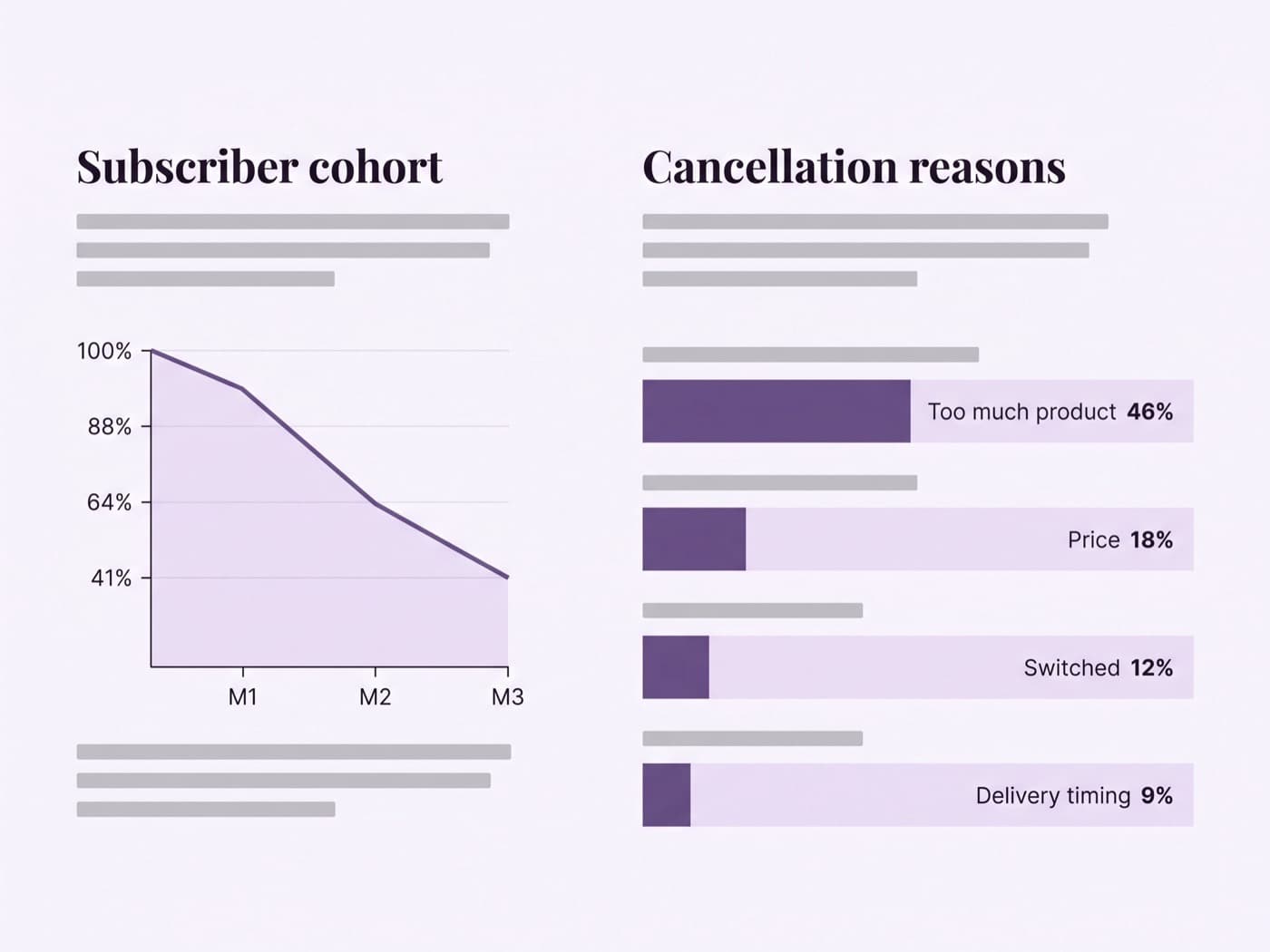
The problem was that 59% of them were gone before the third refill arrived. Month-1 retention looked healthy at 88%, month-2 held at 64%, and then the floor fell out. Nobody internally could say why, because the cancellation form offered three reasons and one of them was "Other", which 44% of people picked.
We rebuilt that form first, before touching anything else, and ran it for five weeks. The answer was not price. The top reason, at 46% of cancellations, was some version of "I already have too much product". People were not leaving because the subscription was bad value. They were leaving because a 30-day cadence was posting them a 50ml serum they used in roughly seven weeks, and the only button that stopped it said Cancel.
Constraints
- The subscription app owns the customer portal. Anything outside its theme-extension surface, the cancel flow especially, had to be rebuilt as a custom app proxy, not styled around.
- About 1,100 new subscribers a month. A cohort that size gives a readable month-3 number roughly every six weeks, not every week. The roadmap had to be paced to the data, not the sprint.
- Cosmetic claims are regulated. Nothing on the cadence screens could imply a clinical outcome, so "your barrier needs 8 weeks" was out and "most people finish this size in 7 weeks" was in.
- A two-person team: one founder handling ops, one part-time developer. Every winner had to survive us leaving.
The approach
How we worked the problem
The brief we wrote back was deliberately narrow: stop treating cancellation as a moment to argue with, and start treating cadence as something the customer is allowed to control. Four workstreams, ordered by how much of the month-3 drop each could plausibly reach.
- 01
Ask better questions at the exit
The rebuilt cancel survey offered eight reasons, a free-text box, and no incentive attached to any answer. 2,300 responses over five weeks. "Too much product" took 46%, price 18%, "switched to something else" 12%, delivery timing 9%, the rest scattered.
We then matched every response to that subscriber's order history. The people citing over-supply had, on average, skipped nothing and cancelled 6 days after a delivery landed. They were not deliberating. They were reacting to a box on the doormat.
- 2,300 cancellation responses, 8 coded reasons
- Every response joined to order and skip history
- Free-text sampled and hand-tagged in batches of 200
- 02
Set the cadence from the product, not the default
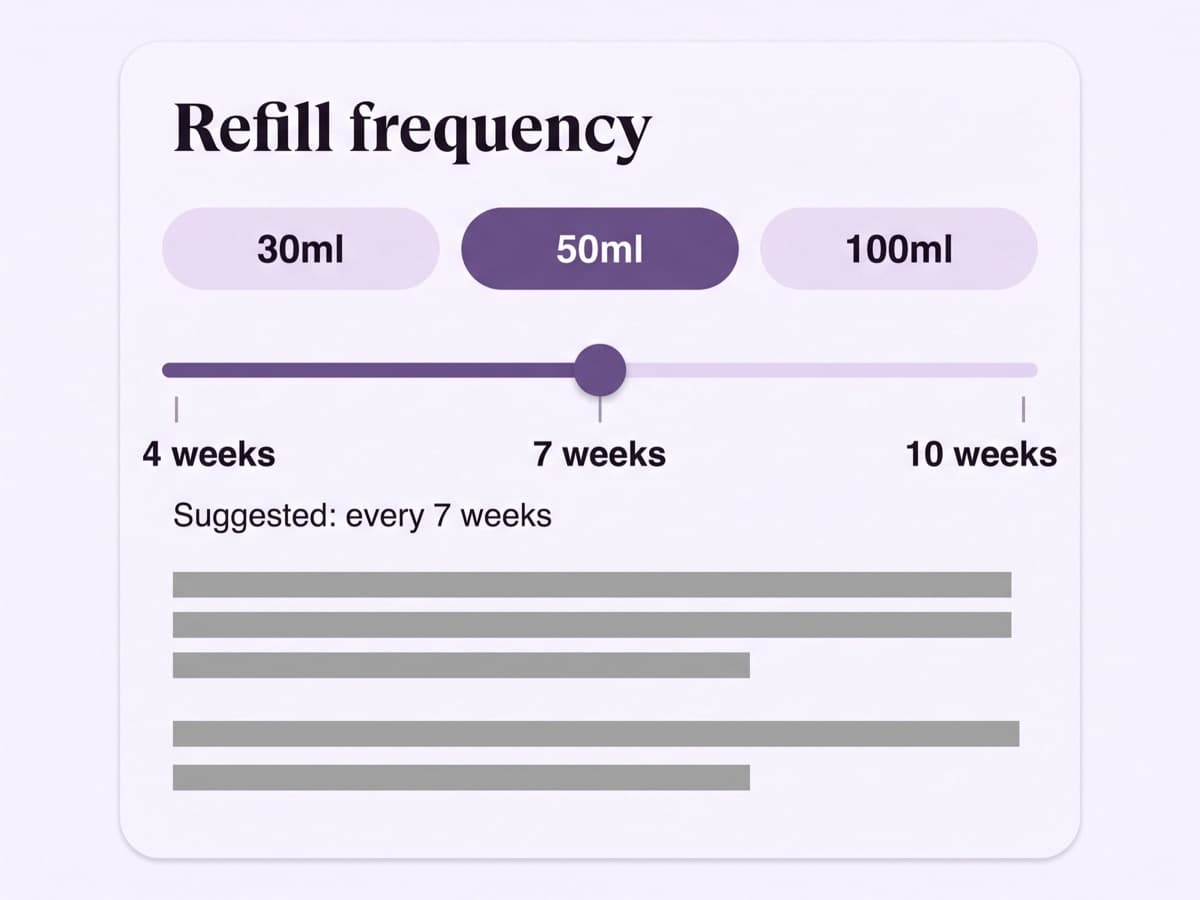
Every product shipped on a 30-day cycle because that was the app default. We replaced signup with a two-question cadence step: which size, and how often do you use it. The answers map to a suggested interval, 7 weeks for the 50ml serum and 5 for the cleanser, which the customer can override on the spot.
Post-purchase, the same control lives on the account home rather than three taps deep inside a portal nobody knew existed. 41% of subscribers changed their interval at least once in the first quarter after launch. Before, it was 4%.
- Per-product usage model, 4 SKUs × 3 sizes
- Interval editable at signup, in email, and in-account
- Suggested intervals worded to avoid any cosmetic claim
- 03
Make the next order visible before it ships
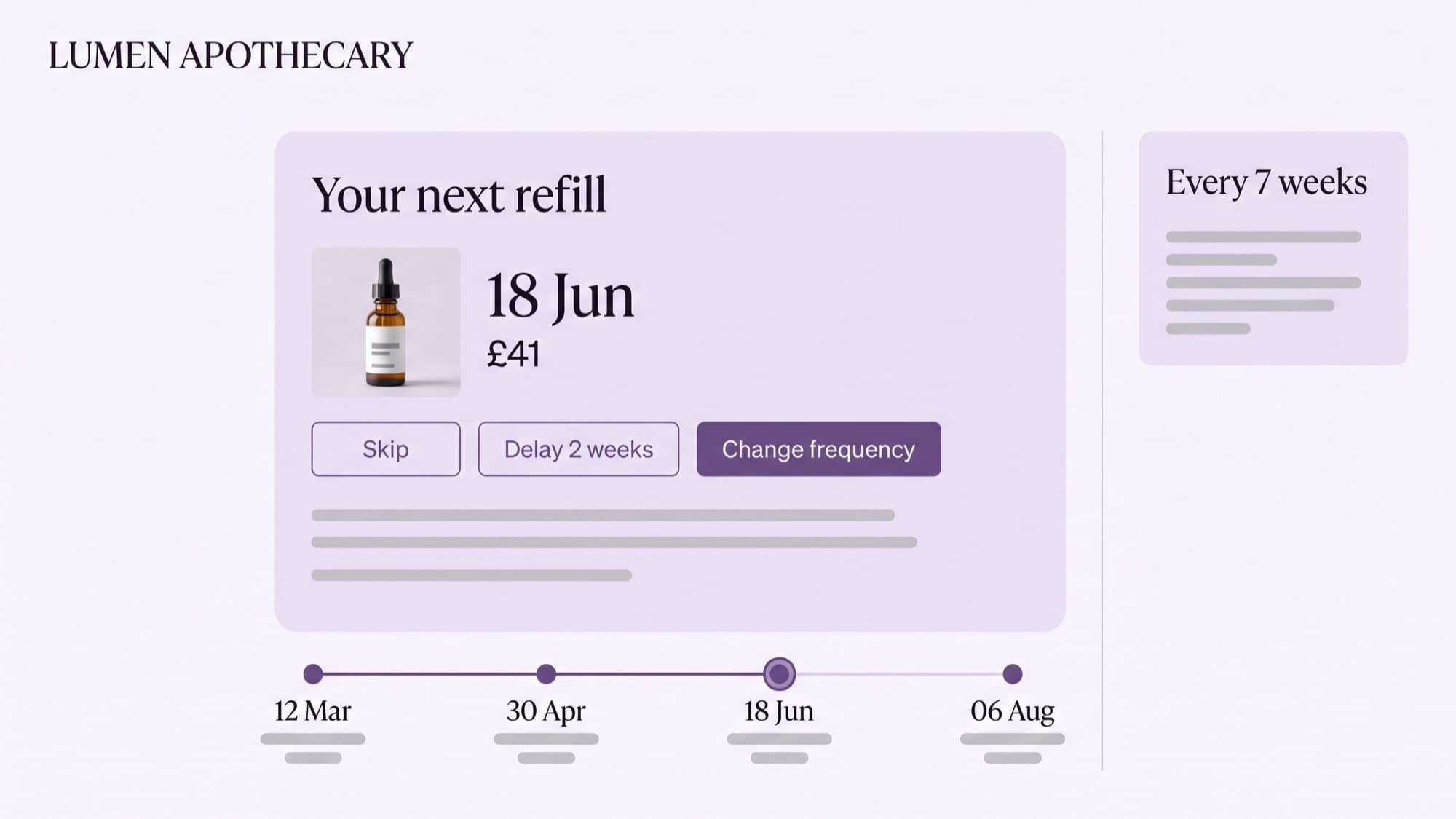
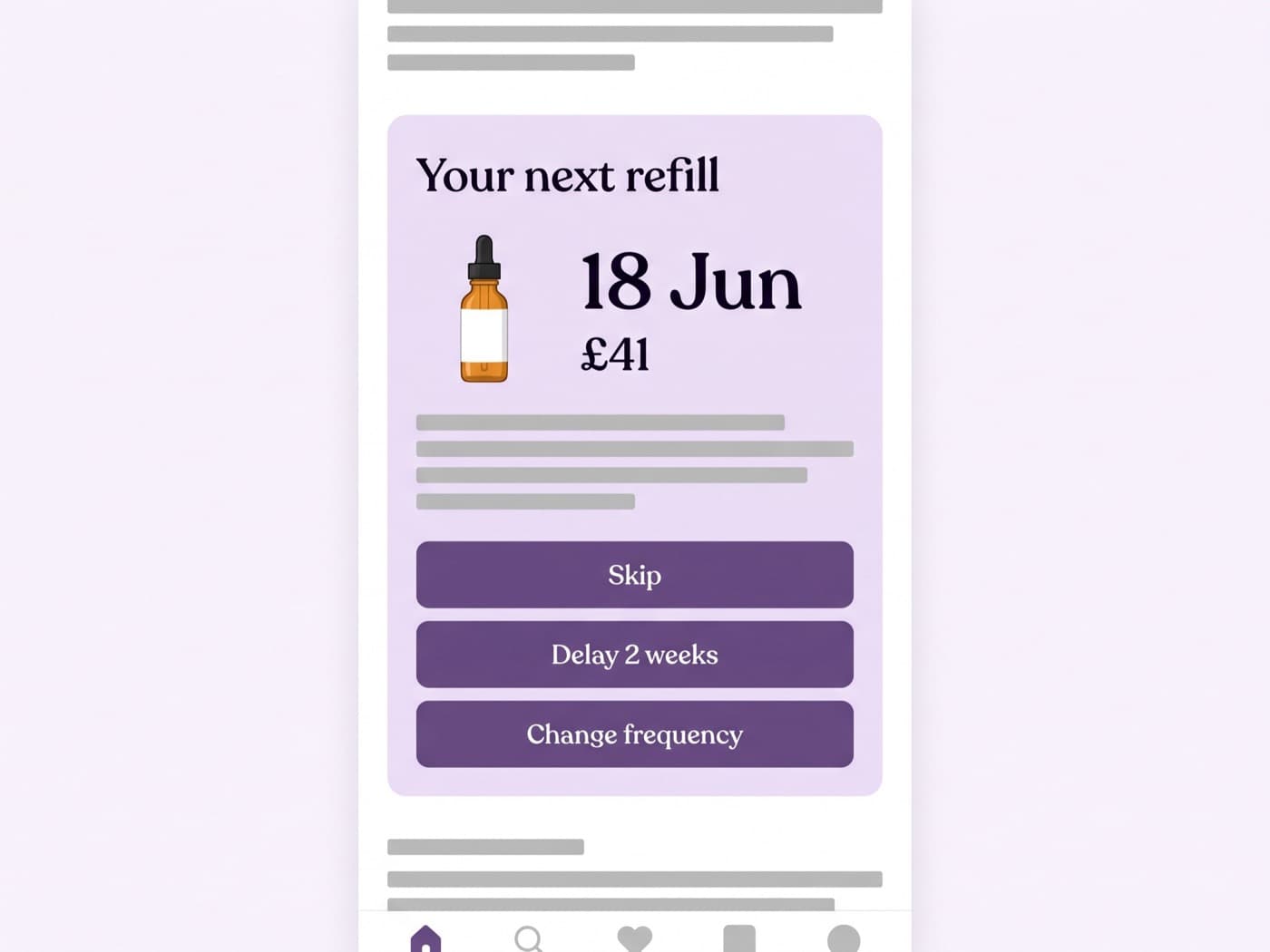
The single biggest structural change was the upcoming-order card: what is coming, on what date, for how much, with skip, delay by a fortnight and change frequency all one tap away. It sits at the top of the account page and it is repeated verbatim in the pre-billing email, which we moved from 3 days out to 7.
A subscription that surprises you is a subscription you cancel. This is the whole insight, and it took four weeks to build.
- Upcoming-order card on account home and in email
- Pre-billing notice moved from 3 to 7 days
- Skip and delay actions work from the email, no login
- 04
Rebuild the cancel flow to offer the right exit
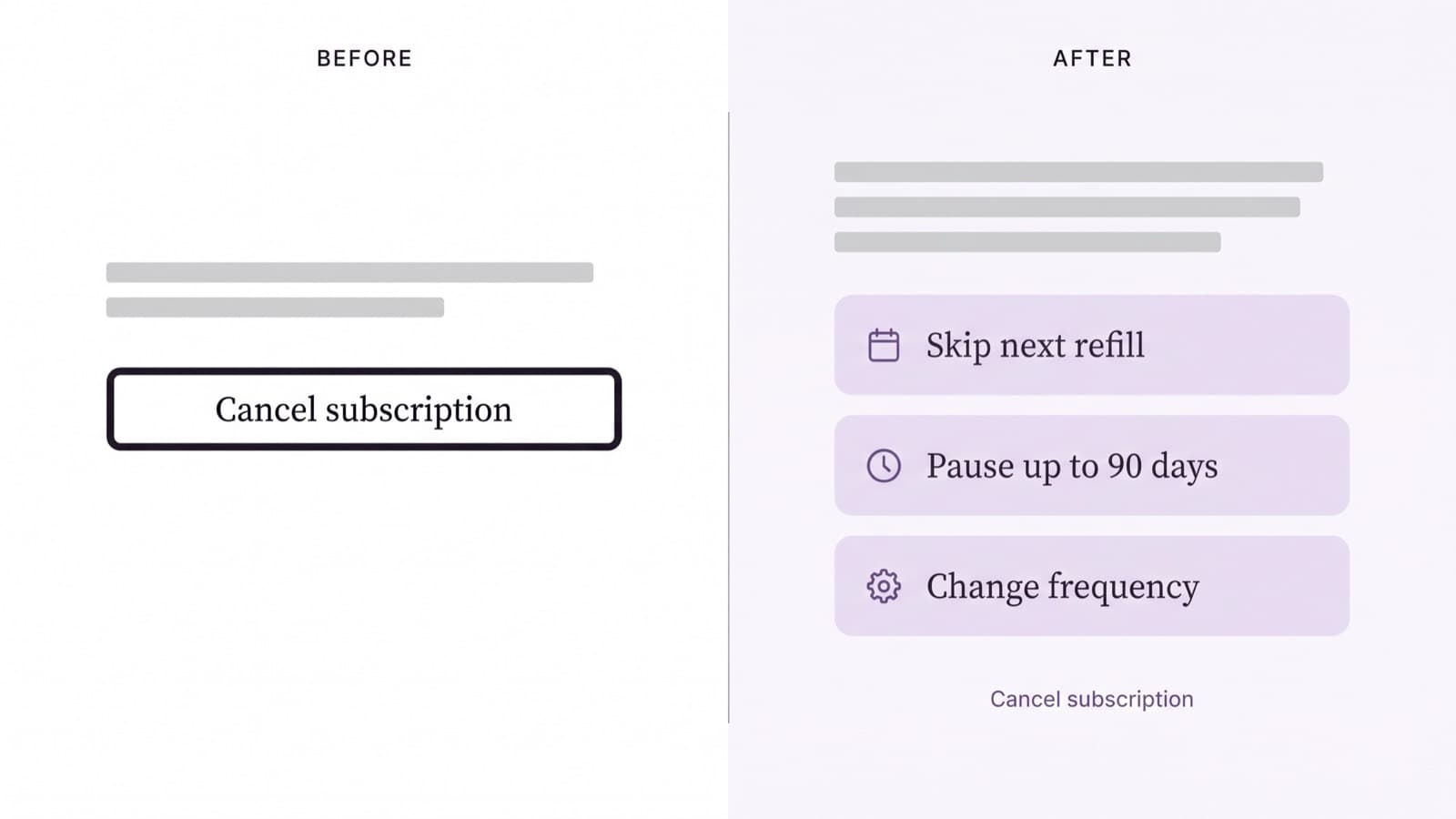
The old flow was one button. The new one asks the reason first, then routes: over-supply gets skip, pause and a longer interval; price gets a smaller size; wrong product gets a swap. Cancel is always present, always one tap, never buried. Burying it just moves the churn to the card issuer.
We also tested the obvious thing everyone asks for, a save-the-subscriber discount, and it was the wrong answer. It is in the log below with the numbers.
- Reason-first routing, 8 branches, custom app proxy
- Cancel link visible on every step of the flow
- Pause capped at 90 days with an auto-resume notice
The log
What we tested
Nine experiments over ten months, read on month-3 cohort retention rather than same-week behaviour. Six that changed how we thought about the problem.
- 01
Cadence question at signup
Because 46% of cancellations cite over-supply, asking size and usage frequency at signup and defaulting the interval from the answer will raise month-3 retention.
- 02
Upcoming-order card with skip and delay
Because over-suppliers cancel within a week of a delivery, showing the next order 7 days out with one-tap skip and delay will convert would-be cancellations into skips.
- 03
Reason-first cancel routing
Because a single cancel button offers no alternative, routing by stated reason to skip, pause, swap or smaller size will cut completed cancellations.
- 04
25% off next refill to save a cancellation
Because price is the second-most-cited reason, a discount offered at the cancel step will retain subscribers who would otherwise leave.
- 05
Founder video on the cancel screen
Because brand attachment correlates with tenure, a 30-second founder message before the cancel confirmation will reduce completed cancellations.
- 06
Refill reminder timed to usage, not billing
Because usage varies by size, a "roughly two weeks left" email based on the usage model will lift skip rates ahead of unwanted deliveries.
- Cadence question at signup+8.9%97%shipped
- Upcoming-order card with skip and delay+11.2%98%shipped
- Reason-first cancel routing+6.4%96%shipped
- 25% off next refill to save a cancellation-5.1%95%not shipped
- Founder video on the cancel screen+0.3%flatnot shipped
- Refill reminder timed to usage, not billing+4.7%95%shipped
| Experiment | Relative change | Confidence | Shipped |
|---|---|---|---|
| Cadence question at signup | +8.9% | 97% | Yes |
| Upcoming-order card with skip and delay | +11.2% | 98% | Yes |
| Reason-first cancel routing | +6.4% | 96% | Yes |
| 25% off next refill to save a cancellation | -5.1% | 95% | No |
| Founder video on the cancel screen | +0.3% | flat | No |
| Refill reminder timed to usage, not billing | +4.7% | 95% | Yes |
The results
What it moved
Month-3 retention moved from 41% to 58% across two quarters and has held there for four cohorts. Average orders per subscriber over twelve months went from 2.95 to 4.27, which at a £41 average refill takes 12-month LTV from £121 to £175, a 45% increase with no change to acquisition spend, pricing or product.
The discount test deserves its own paragraph, because it is the one every subscription brand wants to run. Offering 25% off the next refill at the cancel step did exactly what the pitch promises: it saved 38% of the people who saw it, the best save rate of anything we tested. It also produced 5.1% less revenue per subscriber over the following 90 days than the control. The saved subscribers took the cheap box, did not change their cadence, and cancelled at the next cycle anyway, now with a discounted order in their history and a slightly worse opinion of the brand. It won on the wrong metric. We killed it.
What actually worked was cheaper and duller. People with too much product do not want money off more product. They want the next delivery to stop, and they want to know it has stopped. 34% of subscribers who start the cancel flow now leave it having skipped or paused instead, up from 9%, and 71% of those are still active three months later.
The subscription now runs with the founder editing cadence rules herself. Two of the last three shipped changes were hers.
- Month-3 retention+41%41%58%
- "Too much product" share of cancellations-59%lower is better46%19%
- Cancel starts ending in cancellation-32%lower is better91%62%
- 12-month subscriber LTV+45%£121£175
| Metric | Before | After |
|---|---|---|
| Month-3 retention | 41% | 58% |
| "Too much product" share of cancellations | 46% | 19% |
| Cancel starts ending in cancellation | 91% | 62% |
| 12-month subscriber LTV | £121 | £175 |
| Period | Month-3 retention |
|---|---|
| M1 | 41% |
| M2 | 41% |
| M3 | 43% |
| M4 | 46% |
| M5 | 47% |
| M6 | 51% |
| M7 | 53% |
| M8 | 55% |
| M9 | 57% |
| M10 | 58% |
“They prototyped three PDP directions and tested them before we committed. The winner cut churn by a third.”